Manousakis Changes the GSI Game: Less Risk for IPTO, Stronger Capital for the Great Interconnector
 ΧΡΟΝΟΣ ΑΝΑΓΝΩΣΗΣ 8 '
Πηγή Φωτογραφίας: eurokinissi//Manousakis Changes the GSI Game: Less Risk for IPTO, Stronger Capital for the Great Interconnector



The most important change for the Great Sea Interconnector following the entry of France’s Meridiam is not simply who controls the majority of the project company.
It is that IPTO, under Chairman and CEO Manos Manousakis, is changing the model through which it approaches major international infrastructure projects: retaining a strategic and technical role while avoiding the need to carry the entire capital burden and risk of a project of this scale.
The agreement signed on August 5, under which Meridiam entered Great Sea Interconnector as majority shareholder, should therefore be viewed as more than a corporate transaction.
It represents a new financial architecture for the Greece–Cyprus electricity interconnection.
Alongside it comes a second, more technical but potentially crucial development: a proposed change in the regulatory methodology affecting WACC — the weighted average cost of capital used to determine the regulated return on the project’s asset base.
Together, the two developments point in the same direction: more international capital, a broader distribution of risk and a regulatory model designed to better reflect the actual financing structure of the GSI.
Meridiam takes the majority — IPTO remains at the strategic core
The agreement with Meridiam was signed on August 5 at the Maximos Mansion in the presence of Greek Prime Minister Kyriakos Mitsotakis. On the same day, IPTO, GSI and Nexans signed a trilateral agreement concerning the seabed surveys required for the project’s implementation.
What matters is the new division of roles.
Meridiam brings international infrastructure capital and extensive experience in long-term investments. IPTO remains a strategic shareholder and a central partner, maintaining a key technical role during construction and in the operation of the interconnection.
Mitsotakis described the significance of the deal in financial terms:
“IPTO remains a strategic shareholder and a central partner in this project, while your participation strengthens the capital base, leads to better risk allocation and enhances the ability to implement it.”
This goes to the heart of the transaction.
Manousakis is not simply reducing IPTO’s stake in the GSI. He is bringing a major international infrastructure investor alongside the Greek operator so that the project gains greater financial depth while the risks are no longer concentrated on IPTO alone.
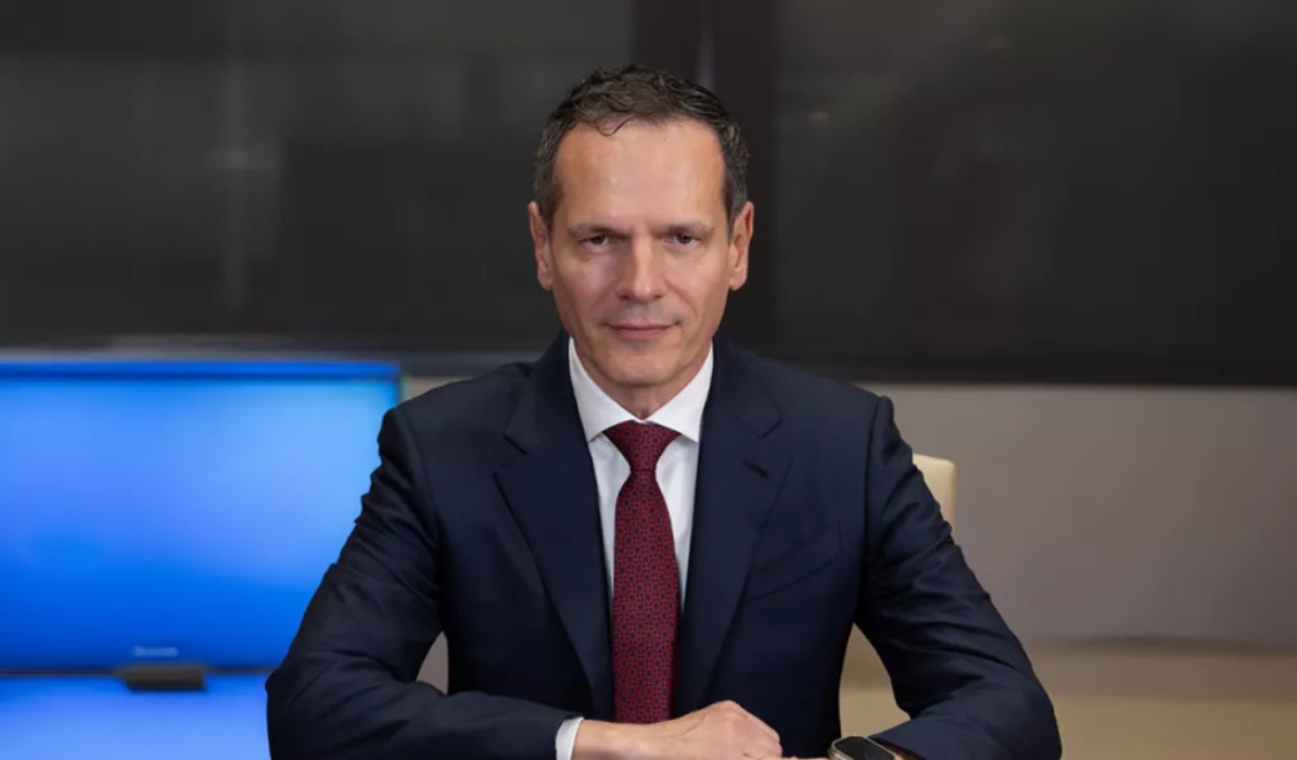
The Manousakis model: strategic control without carrying the entire capital burden
This is where the agreement deserves a broader reading.
IPTO is already implementing an ambitious domestic investment programme involving new island interconnections, grid reinforcement, greater capacity for renewable energy and infrastructure needed for Greece’s increasingly interconnected electricity system.
Every euro committed to a major international project therefore has an opportunity cost.
The partnership with Meridiam allows IPTO to remain strategically involved in the GSI and deploy the expertise accumulated through complex projects such as the Crete–Attica interconnection, while sharing the investment burden with an international infrastructure investor.
The Greek prime minister explicitly described Meridiam’s entry as a vote of confidence in both the Greek energy sector and IPTO’s technical capabilities.
“Meridiam’s entry as majority shareholder […] constitutes a very strong vote of confidence in Greece’s energy sector, in IPTO’s technical capabilities, but also in the strategic value of this interconnection project.”
Then comes the WACC question
The second development is less politically visible, but potentially just as important financially.
At its centre is the project’s gearing ratio: the proportion of debt versus equity assumed by the regulatory framework when calculating the financing of the GSI.
Under the proposed methodology, instead of an assumed debt financing ratio potentially ranging between 60% and 80%, lower levels are proposed: 50%-60% during construction and 40%-50% during the regulatory depreciation period.
Why does that matter?
Because debt and equity do not carry the same cost.
An equity investor assumes greater risk than a lender and therefore generally requires a higher return.
If the regulatory calculation reduces the weight assigned to cheaper debt and increases the weight of equity, the project’s WACC could rise — assuming all other parameters remain unchanged.
And WACC matters because it is used to determine the return on the Regulated Asset Base.
Not a “gift” to IPTO — what the change is actually trying to address
This distinction is critical.
A potentially higher WACC should not automatically be interpreted as simply “higher profits for IPTO.”
The underlying issue is whether the regulatory model accurately reflects the real financing structure of an unusually large, capital-intensive and complex cross-border project.
During construction, the entire debt package is not necessarily drawn from day one. Borrowing rises as works advance and financing is disbursed. Once the project enters operation, repayments gradually reduce outstanding debt.
A gearing ratio that remains theoretically fixed for decades may therefore fail to accurately represent the project’s financial lifecycle.
The proposed approach would make gearing more dynamic, allowing it to be reassessed across regulatory periods and individual years on the basis of actual borrowing, disbursements, repayments and the remaining economic life of the asset.
The red line: consumers cannot carry disproportionate costs
There is, however, an essential counterweight.
Improving the financial investability of a major infrastructure project cannot mean transferring disproportionate costs to electricity users.
The regulatory challenge is therefore to balance two objectives: ensuring that GSI remains financeable and attractive to long-term international capital, while keeping regulated returns reasonable from the perspective of consumers.
This is why a higher WACC is not automatic, nor can its potential size be calculated at this stage.
The outcome will depend on the final gearing ratio approved by the regulator, the cost of debt, the cost of equity and the other components of the methodology.
From a Greek cable to an international infrastructure asset
The bigger story, however, goes beyond financial formulas.
Until recently, much of the debate surrounding the GSI focused on whether and how the interconnector could actually be built.
Meridiam’s entry changes that narrative.
A major global infrastructure investor is now committing capital and assuming a majority position in an interconnector in which IPTO retains a strategic and technical role.
And the strategy does not stop in Cyprus.
Only days after the Meridiam agreement, IPTO submitted the investment request to the relevant regulatory authorities for the Cyprus–Israel section of the Great Sea Interconnector, which the operator said proved viable under all scenarios examined.
This is where Manousakis’ broader strategy becomes clearer.
The objective is no longer merely to build another subsea cable.
It is about positioning IPTO at the centre of an emerging electricity architecture in the Eastern Mediterranean, with Greece potentially serving as a gateway between European and regional energy systems.
Manousakis’ bigger bet
If the model succeeds, IPTO will have achieved something more significant than securing favourable economics for a single project.
It will have demonstrated that a Greek transmission system operator can develop international energy infrastructure without having to finance every euro itself or retain every unit of project risk on its own balance sheet.
Meridiam provides financial depth and risk-sharing. IPTO contributes engineering expertise, interconnection experience and electricity-system know-how. The evolving regulatory framework, meanwhile, is intended to place that partnership on a financing structure capable of working over several decades.
That is the real story behind the WACC debate.
It is not simply about extracting a slightly higher return from a cable. It is about Manousakis turning Greece’s interconnection expertise into a platform capable of attracting global capital — and using IPTO to place Greece at the heart of the Eastern Mediterranean’s emerging energy geography.
Source: pagenews.gr
Διαβάστε όλες τις τελευταίες Ειδήσεις από την Ελλάδα και τον Κόσμο