Greece Back Under the Ratings Microscope: Debt Becomes the New Weapon for an Upgrade
 ΧΡΟΝΟΣ ΑΝΑΓΝΩΣΗΣ 8 '

Πηγή Φωτογραφίας: eurokinissi//Greece Back Under the Ratings Microscope: Debt Becomes the New Weapon for an Upgrade



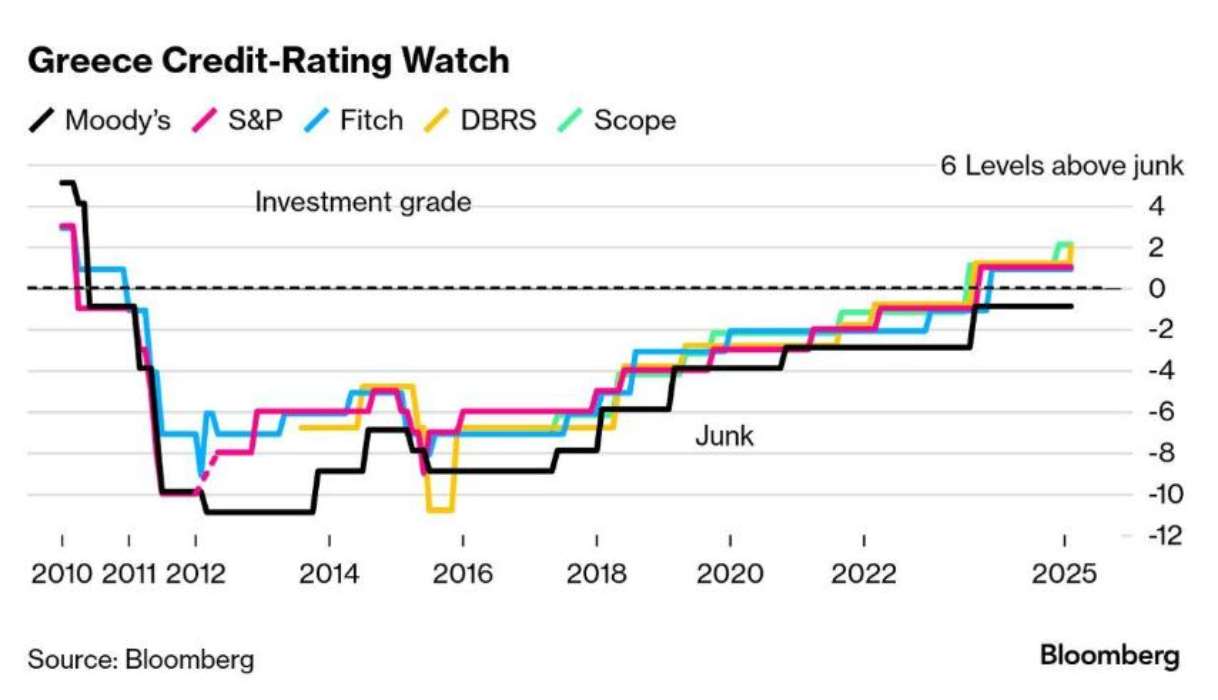
Greece enters the second round of sovereign credit assessments for 2026 with the balance of the debate shifting decisively in its favor.
For years, the country had to convince markets and rating agencies that it could restore fiscal credibility, regain investment grade and leave the sovereign debt crisis behind.
Now the question is different.
Can Greece’s rapidly falling debt ratio, persistent primary surpluses and economic resilience — even under severe geopolitical and energy pressure — become the catalyst for the next round of upgrades?
DBRS opens the ratings calendar on September 4, followed by Scope Ratings and Moody’s on September 18, S&P on October 23 and Fitch on November 6.
But the real story behind those dates is much bigger:
Greece is gradually moving from being defined by the size of its debt to being judged by the speed at which that debt is falling.
The 138.2% target could already prove conservative
The government expects public debt to fall to 138.2% of GDP by the end of 2026, from 145.9% in 2025.
At the same time, Finance Minister Kyriakos Pierrakakis has pointed to another €12.8 billion in early debt repayments, strengthening the possibility that the official debt target could be outperformed.
That matters enormously to the rating agencies.
Greece still carries one of Europe’s largest sovereign debt burdens.
But the distinction between a country with very high and rising debt and one with very high but rapidly declining debt is fundamental for investors.
And increasingly, Greece belongs to the second category.
Scope’s 107% scenario could transform Greece’s debt story
Scope Ratings offers perhaps the most striking example of how quickly expectations are changing.
Its earlier baseline projected Greek public debt at around 127% of GDP in 2030 and 120% in 2035.
A more optimistic subsequent assessment pointed to the possibility of the ratio declining to around 107% by 2031.
If that trajectory materializes, something once almost unthinkable could happen:
Greece could eventually carry a lower debt-to-GDP ratio than Italy — and potentially than other major European economies such as France and Belgium.
For the country that became synonymous with the eurozone sovereign debt crisis, that would represent a remarkable reversal.

Moody’s may be the rating decision to watch
Moody’s deserves particular attention.
Its previous assessment assumed a slower reduction in Greece’s debt burden, with the ratio remaining close to 140% of GDP in 2027.
Fiscal performance and accelerated early repayments increasingly suggest that this forecast could prove conservative.
More importantly, Moody’s has previously indicated that significantly faster debt reduction than expected could create upward pressure on Greece’s sovereign rating.
That makes its September 18 decision particularly interesting.
The question will be whether the agency merely revises its debt projections — or begins translating that improvement into a stronger credit assessment.
Greece is passing a different kind of stress test
The international environment makes the timing of these assessments even more significant.
The Middle East conflict, restrictions affecting energy flows through the Strait of Hormuz and elevated oil and natural gas prices have created precisely the type of external shock that can expose the weaknesses of highly indebted economies.
Yet Greece has so far remained resilient.
GDP expanded by 2% year-on-year in the first quarter of 2026, while the January-July state budget recorded a primary surplus of €5.77 billion, above target.
This gives the rating agencies an important new piece of evidence.
They are no longer assessing how Greece performs only when international conditions are favorable.
They can now examine how the economy, fiscal accounts and debt dynamics behave when the external environment turns hostile.
DBRS: Stronger debt dynamics, but geopolitics remains the risk
DBRS had already identified this tension.
On one side are Greece’s improved fiscal fundamentals, economic growth and falling public debt.
On the other is an increasingly unstable geopolitical environment capable of transmitting shocks through energy prices, trade and financial markets.
That makes the September assessment particularly important.
One of the key conditions for further improvement — sustained debt reduction — appears increasingly strong.
But one of the principal downside risks identified by the agencies — geopolitics — has also intensified.
How DBRS balances those two forces could offer an early signal for the agencies that follow.
Fitch: The easy phase of the recovery is ending
Fitch introduces a more difficult question.
The agency recognizes that rapid debt reduction has been one of the main catalysts behind Greece’s upgrades in recent years.
But some of the extraordinary forces supporting the recovery are beginning to fade.
The post-pandemic tourism rebound has matured.
EU Recovery and Resilience Facility funding reaches its peak.
And the period of exceptionally favorable real financing conditions is over.
The next stage will therefore depend more heavily on Greece’s ability to generate sustained primary surpluses and stronger underlying productivity growth.
And that comes precisely as the country faces rising defense spending, demographic ageing and increasing political pressure for higher public expenditure.
This is where Greece’s next credit test becomes harder than the previous one.
What another upgrade actually means for the economy
A sovereign upgrade is not merely symbolic.
Lower perceived sovereign risk can reduce the premium investors demand to hold Greek government bonds.
That can strengthen the pricing of Greek assets, support banks and improve financing conditions for companies.
The sovereign essentially establishes a risk benchmark for much of the domestic economy.
A lower country-risk premium therefore has the potential to filter gradually through the financial system.
It does not mean that a ratings upgrade immediately reduces every mortgage or business loan.
But structurally cheaper sovereign financing can ultimately lower the cost of capital across the economy.
And that matters for investment, productivity and growth.
Italy could become the new debt benchmark
There is also a powerful European dimension.
For decades, Greece represented the extreme case of excessive sovereign indebtedness in the euro area.
If current trajectories continue, Italy could increasingly occupy that position instead.
The significance is not that Greek debt suddenly becomes “low.”
It clearly does not.
The significance is the direction of travel.
A country once regarded as Europe’s most acute sovereign debt risk could find itself reducing its debt ratio considerably faster than several economies traditionally regarded as safer.
That changes investor psychology.
And eventually it can change ratings.
Greece is changing its benchmark
This is the deeper meaning of the second ratings round.
The question is no longer simply whether Greece can preserve investment grade.
That battle has largely been won.
The next question is whether the country can begin escaping the analytical category that defined it for more than a decade.
For years, virtually every assessment of Greece started with one sentence: public debt is exceptionally high.
Increasingly, the conversation is becoming:
how quickly can that exceptionally high debt fall?
That is a major shift.
But the next phase will also be more demanding.
Athens must prove that debt reduction can continue after Recovery Fund inflows peak, after the extraordinary tourism rebound normalizes and while defense, demographic and energy pressures intensify.
If Greece can do that, the story will no longer be simply about recovering from the debt crisis.
It will become a story of sovereign convergence.
And that is the real prize behind the coming decisions from DBRS, Moody’s, Scope, S&P and Fitch: not another letter on a ratings scale, but the gradual repricing of Greece itself in European and global markets.
Source: pagenews.gr
Διαβάστε όλες τις τελευταίες Ειδήσεις από την Ελλάδα και τον Κόσμο