Androulakis Takes Aim at Funds and Servicers: “The Profiteering Party Is Over”
 ΧΡΟΝΟΣ ΑΝΑΓΝΩΣΗΣ 11 '
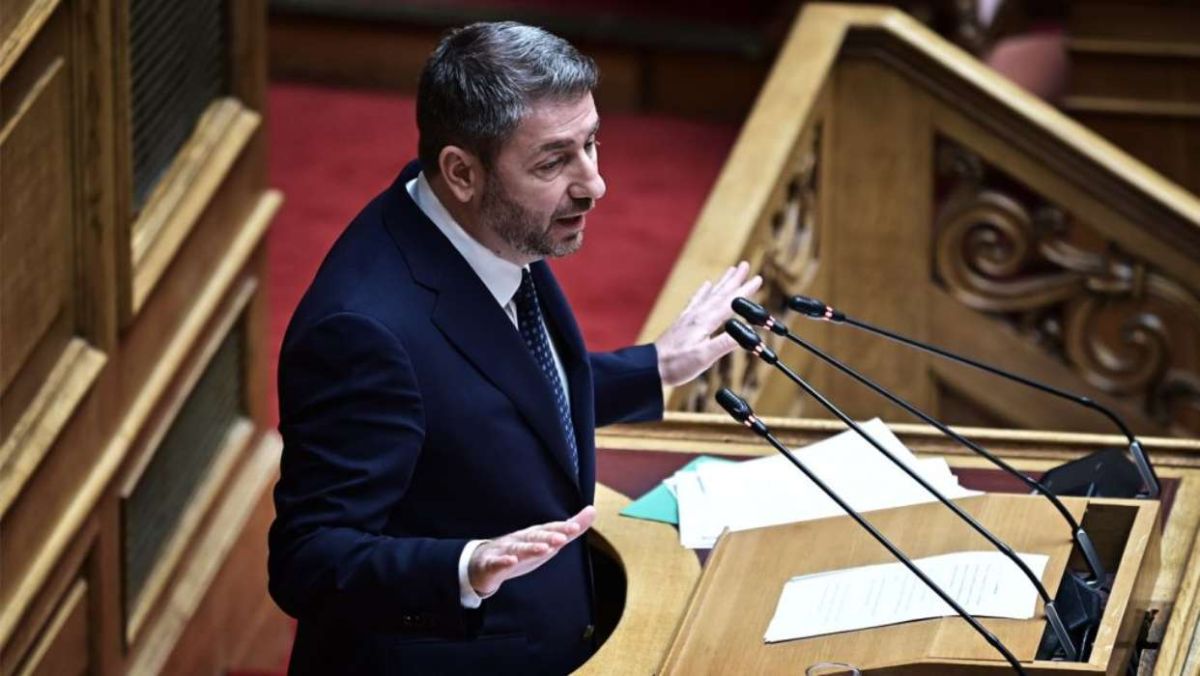
Πηγή Φωτογραφίας: eurokinissi//Androulakis Takes Aim at Funds and Servicers: “The Profiteering Party Is Over”



Nikos Androulakis is moving to turn private debt into one of PASOK’s defining political battlegrounds, challenging both the Mitsotakis government and Alexis Tsipras while seeking to demonstrate that his party can offer a concrete alternative on one of Greece’s most persistent social and economic problems.
The PASOK leader is no longer limiting himself to broad commitments. Immediately after the Thessaloniki International Fair, PASOK intends to submit its private-debt plan to Parliament as a formal legislative proposal.
The package includes renewed protection for primary residences, repayment of debts to the state in up to 120 installments, tougher rules for loan servicers, a right of first refusal for borrowers before loans are transferred to funds, and a dedicated settlement mechanism for Swiss-franc loans.
Androulakis is framing the parliamentary move as a political test for every party.
“Then the masks will fall. We will see who serves the people and who serves the powerful,” he argues.
Private debt becomes a political battlefield
The scale of the problem is central to Androulakis’ case.
According to figures cited by the PASOK leader, nearly €80 billion in loans have left bank balance sheets and are now held in fund portfolios under the management of servicers.
Servicers, he says, manage more than €92 billion in loans involving over 2.6 million debtors. At the same time, around 3.5 million citizens owe money to the tax authorities, while more than 1.6 million are already facing compulsory collection measures.
Behind those figures, Androulakis argues, are households at risk of losing their homes, small businesses struggling to regain access to liquidity and entrepreneurs unable to make a fresh start because of legacy debt.
“The problem of private debt is not only economic. It threatens social cohesion and undermines the country’s growth potential,” he says.
That is the broader political argument PASOK is now seeking to establish: Greece may have cleaned up much of the non-performing-loan problem on bank balance sheets, but the debt itself did not disappear from Greek society.
“A strategic defaulter is not the same as someone who wants to pay”
Androulakis is careful to draw a line between debt relief and blanket protection for non-payers.
“A strategic defaulter is one thing, and a citizen who wants to pay but cannot do so under the current terms is another. Business insolvency is one thing, and a viable small or medium-sized company suffocating under old debts is another,” he writes.
His proposed doctrine is therefore two-sided: the state should remain strict with those who systematically evade their obligations while offering a genuine second chance to viable households and businesses.
This allows PASOK to present its approach as neither indiscriminate debt forgiveness nor an unrestricted market for distressed debt.
Bringing back primary-home protection
A central element of the proposal is the restoration of a framework protecting the primary residence, inspired by the mechanism introduced under Law 3869/2010 during a previous PASOK government.
Androulakis is deliberately invoking PASOK’s record.
He argues that even during one of the most difficult fiscal periods in modern Greek history, the party established an effective protection framework for thousands of households.
The political message is straightforward: if such protection was possible during the sovereign-debt crisis, PASOK argues, it should be possible to design targeted safeguards today.
120 installments for debts to the state
PASOK also proposes allowing eligible debts to the state to be settled in up to 120 installments, accompanied by meaningful incentives for debtors who consistently comply with the repayment agreement.
The objective, according to Androulakis, is not simply to stretch existing liabilities over a longer period but to create a credible route back into economic normality.
The distinction matters politically. PASOK wants to present debt restructuring not merely as social assistance but as a tool that could return households and viable businesses to the productive economy.
Overhauling the out-of-court mechanism
Androulakis also promises major changes to Greece’s out-of-court debt settlement mechanism.
“The out-of-court mechanism will cease to be a bureaucratic waiting room for new dead ends and will become a genuine instrument of restructuring and a second chance,” he says.
PASOK argues that borrowers need a more effective route toward sustainable settlements rather than a process in which the balance of negotiating power remains overwhelmingly with creditors and servicers.
The potentially disruptive proposal: A borrower’s right of first refusal
Perhaps the most politically significant element of the plan is PASOK’s proposed right of first refusal for borrowers.
The idea is that before a distressed loan is transferred to a fund, the borrower would have an opportunity to settle the debt under reasonable terms related to the price at which the claim is being sold.
In practical terms, PASOK is asking a politically explosive question:
If a fund can acquire a distressed loan at a substantial discount, why should the borrower not receive a final opportunity to reach a settlement before that loan enters the secondary market?
Androulakis insists that such a mechanism does not inherently conflict with European rules and accuses the government of invoking Europe as a justification for its reluctance to legislate in this direction.
That claim will inevitably become one of the most closely scrutinized parts of PASOK’s legislation once the actual text reaches Parliament.
Androulakis targets the servicers
The PASOK leader is also promising a much tougher regulatory framework for loan-servicing companies, based on transparency, accountability and enforceable rules.
His sharpest criticism concerns potential conflicts of interest between loan management, foreclosure procedures and the eventual acquisition of the underlying property.
“There cannot be a mechanism that manages the loan, initiates the auction and at the same time is connected to the acquisition of the property. These triangular relationships will be investigated,” he says.
Then comes his most politically aggressive line:
“With PASOK, the profiteering party will end.”
It is a phrase designed to move the debate beyond technical banking policy and turn it into a broader argument about economic power and who sets the rules of the market.
Swiss-franc loans: Banks take two-thirds of the currency risk
Androulakis is also proposing a specific settlement for borrowers with loans denominated in Swiss francs.
PASOK’s formula would allocate the exchange-rate burden:
two-thirds to the bank and one-third to the borrower.
The principle behind the proposal is that the consequences of an extreme currency movement should not fall exclusively on households.
The party will need to spell out the precise legal, fiscal and banking implications when it tables its bill, but the political commitment is already clear.
Agricultural land, guarantors and business accounts
The wider package also includes protection for agricultural land, what PASOK describes as fairer rules for guarantors, and a protected business account that would be shielded from seizure under specified conditions.
This broadens the plan well beyond mortgages.
Androulakis is attempting to connect private debt with the financing of the real economy, small businesses, agricultural production and the ability of viable entrepreneurs to regain economic freedom.
A two-front attack on Mitsotakis and Tsipras
Politically, Androulakis is attempting something more ambitious than another opposition attack on the government.
He is drawing a line against both Kyriakos Mitsotakis and Alexis Tsipras.
On Tsipras, he recalls the promises of “seisachtheia” — sweeping debt relief — and the slogan that no home would end up in bankers’ hands. He then points to the SYRIZA–ANEL government’s opening of the non-performing loan market to funds and the introduction of electronic auctions.
His argument against Mitsotakis is different.
Androulakis claims that New Democracy took the path opened under SYRIZA and expanded it, creating what he describes as an excessively favorable environment for funds and servicers while failing to provide sufficient protection for primary residences.
The strategic objective is unmistakable.
PASOK wants to occupy political territory between Tsipras and Mitsotakis without becoming an appendage of either.
PASOK reaches for its historical identity
Androulakis is also deliberately reconnecting the proposal with PASOK’s political history.
He points to the 2010 household insolvency law as evidence that the party has previously created borrower protections under conditions far more difficult than those Greece faces today.
“Our party has never exploited society’s dead ends by handing out cost-free promises and deceiving citizens for the sake of power,” he argues.
The language is designed to support the identity Androulakis increasingly wants PASOK to project: socially interventionist but institutionally credible; willing to confront concentrated economic power without abandoning fiscal responsibility.
The real battle begins after TIF
The most important part of Androulakis’ intervention may therefore be the timetable.
PASOK is promising to take the plan to Parliament immediately after the Thessaloniki International Fair.
That means the political debate will move from television studios and speeches to an actual legislative text.
“Then the masks will fall,” Androulakis says.
Once the proposal is formally tabled, the government and the other opposition parties will have to respond not merely to a political slogan but to individual provisions covering home protection, servicers, repayment schemes and distressed-loan transfers.
Androulakis searches for his governing issue
There is a larger political calculation behind the 11 commitments.
Androulakis does not merely want PASOK to be seen as an opposition party criticizing the government. He needs to convince voters that it can produce legally workable answers to difficult questions of government.
Private debt offers precisely that opportunity because it sits at the intersection of housing, banking stability, social protection, small-business liquidity, tax arrears and economic growth.
It also gives PASOK an issue on which it can simultaneously distinguish itself from New Democracy and challenge Tsipras’ claim to dominate the progressive opposition.
Androulakis sums up that ambition in explicitly political terms:
“Greece needs a government that will set rules for the market, confront powerful interests where necessary and give citizens genuine opportunities to create and move forward.”
And his conclusion leaves no ambiguity about PASOK’s objective:
“Only PASOK can guarantee this political change.”
The next test, however, will not be another speech.
It will be the bill itself.
And once it reaches Parliament, Androulakis wants to force every political force to answer one uncomfortable question: when a viable borrower can still be rescued, who should have the stronger hand — the citizen trying to settle the debt, or the fund preparing to buy the claim?
Source: pagenews.gr
Διαβάστε όλες τις τελευταίες Ειδήσεις από την Ελλάδα και τον Κόσμο