Georgiadis: Netanyahu’s Ballot-Box Lesson and New Democracy’s 30% Poll Rating
 ΧΡΟΝΟΣ ΑΝΑΓΝΩΣΗΣ 4 '

Πηγή Φωτογραφίας: eurokinissi//Georgiadis: Netanyahu’s Ballot-Box Lesson and New Democracy’s 30% Poll Rating



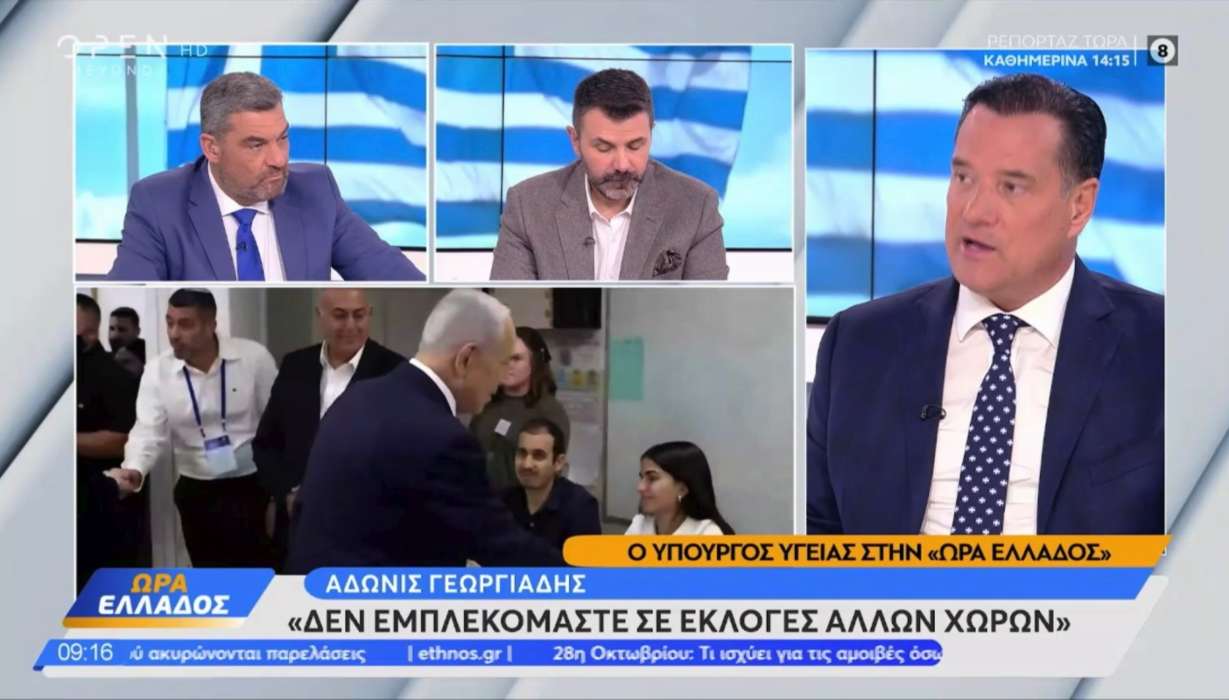
“The people of Israel exercised their sovereign right to vote.”
With those words, Greek Health Minister Adonis Georgiadis commented on the initial picture emerging from Israel’s election, contrasting Likud’s resilience with predictions of Benjamin Netanyahu’s political demise.
During the same OPEN TV interview, the discussion turned to Greece, with the presenters referring to New Democracy polling at around 30%. That figure concerned the Greek governing party, not Netanyahu, and no specific survey was identified in the excerpt.
The political thread connecting the two discussions was caution against premature certainty: voters ultimately determine a party’s strength, while the formation of a government depends on electoral rules and viable alliances.
Predictions of Netanyahu’s Collapse Meet the Ballot Box
Georgiadis argued that Likud’s first-place showing in the initial exit polls did not support expectations that Netanyahu would disappear from the political scene.
He referred to Israelis as a “friendly people” and an “allied people”, emphasising participation and the democratic process.
His central argument was that criticism of a government does not diminish the obligation to respect the choices of its electorate.
He also made clear that Greece does not intervene in other countries’ elections, particularly those of friends and allies.
The distinction matters for Greek foreign policy: a strategic relationship with Israel needs institutional continuity beyond any individual leader or election campaign.
Screenshot
The Largest Party Does Not Automatically Form the Government
The initial exit polls from major Israeli broadcasters projected 24–25 seats for Likud, without a parliamentary majority for Netanyahu’s political camp.
Those first estimates placed his bloc at approximately 50 seats, compared with 52–53 for the opposition. A majority in the 120-member Knesset requires 61 seats.
These were initial projections, subject to revision and distinct from official results.
Georgiadis acknowledged the complexity of government formation under Israel’s proportional electoral system.
Netanyahu’s political resilience and his ability to remain prime minister are separate questions. Leading the largest party provides negotiating weight, but it does not replace the need to secure parliamentary support.
Recognition for Eisenkot
Georgiadis also spoke positively about Netanyahu’s rival, Gadi Eisenkot, describing him as a:
“Distinguished personality.”
That recognition broadened his assessment beyond support for Netanyahu’s electoral endurance. It acknowledged the strength of competing leadership figures within Israel’s political system.
From Athens’ perspective, cooperation with Israel benefits from relationships that extend across institutions and political leaderships.
The immediate question remains which candidate can translate electoral support into a workable governing arrangement.
What New Democracy’s 30% Means
When the presenters raised New Democracy’s roughly 30% standing in recent polls, Georgiadis maintained that a single-party parliamentary majority remained his preferred outcome.
The number cited during the interview cannot, by itself, support a reliable seat projection. Without an identified survey, it is unclear whether it referred to raw voting intention or an adjusted election estimate, or how undecided voters were treated.
It therefore cannot automatically establish either an assured majority or an electoral ceiling.
The comparison with Israel is primarily political: a party can retain considerable support despite intense criticism of its leader. But different electoral systems create different routes to power, and Israel’s coalition arithmetic cannot be transferred directly to Greece.

Screenshot
Respect for Voters, Continuity Between Allies
Georgiadis’s intervention defended the right of Israeli citizens to choose their leadership through democratic competition, challenging assumptions about which politicians voters should reject.
Strong participation and a competitive contest underline the importance Israelis attach to their country’s leadership and future.
For Greece, the practical diplomatic priority is a durable relationship with Israel, supported by cooperation that can continue through political change.
Georgiadis placed the final authority with the electorate:
“The people of Israel exercised their sovereign right to vote.”
Source: pagenews.gr
Διαβάστε όλες τις τελευταίες Ειδήσεις από την Ελλάδα και τον Κόσμο