Iran Moves on Baghdad: Ghalibaf’s Mission Links Militias, Oil and the Battle for Iraq
 ΧΡΟΝΟΣ ΑΝΑΓΝΩΣΗΣ 7 '
Πηγή Φωτογραφίας: AP Photo//Iran Moves on Baghdad: Ghalibaf’s Mission Links Militias, Oil and the Battle for Iraq



Iran is intensifying its diplomatic engagement with Iraq at a moment when Baghdad is being squeezed between Washington’s demands, Tehran’s regional influence and an energy crisis that directly threatens the Iraqi economy.
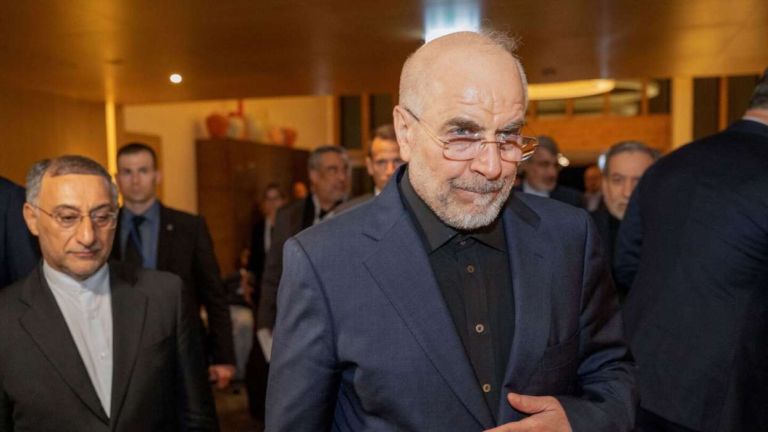
Iranian Parliament Speaker Mohammad Bagher Ghalibaf arrived in Baghdad on Wednesday for high-level talks, becoming the second senior Iranian official to visit Iraq this month. His trip comes only weeks before a politically explosive September 30 deadline for armed groups to surrender their weapons and integrate fully into Iraq’s state security structures.
But weapons are only one part of the equation.
Oil, the Strait of Hormuz and the future of the American military presence are increasingly intertwined with the struggle over Iran’s influence inside Iraq.
Ghalibaf’s visit therefore carries significance far beyond parliamentary diplomacy.
Tehran sends a message from the site of Soleimani’s killing
Ghalibaf began his visit with a highly symbolic stop at the location where Quds Force commander Qasem Soleimani and Iraqi militia leader Abu Mahdi al-Muhandis were killed by a US drone strike in January 2020.
Standing at the site, the Iranian official described relations between Tehran and Baghdad as “unbreakable” and argued that American influence across the region was declining.
“American forces are seeking a dignified exit plan from the region,” Ghalibaf said, while also claiming that Israel “no longer has a future in our region.”
The symbolism was unmistakable. Iran is signalling that despite years of confrontation with Washington, its political and security relationships inside Iraq remain strategically important.
أبو مهدي والحاج قاسم العزيزان! ها هي ثمرة جهادكما ودمكما المبارك.
في النظام الإقليمي الجديد، أخذ تدخل القوى الأجنبية في المعادلات بين الدول ينحسر بشكل متسارع؛ فأمريكا تبحث عن مخرج مشرّفٍ لها من المنطقة وبات مشروع من النهر إلى البحر للكيان الصهيوني محضَ أضغاث أحلام. #أخوتنا_قوتنا pic.twitter.com/bKHFyeNxPv
— محمدباقر قالیباف | MB Ghalibaf (@mb_ghalibaf) August 19, 2026
September 30: The battle over the militias
The timing is particularly sensitive because Baghdad has established September 30 as the deadline for militias to surrender their weapons and integrate into official state security structures.
The issue directly affects some of Iran’s most important regional allies.
The Popular Mobilization Forces encompass numerous predominantly Shiite armed formations, several of which have developed close relationships with Tehran. Although formally incorporated into Iraq’s security architecture, parts of the network continue to maintain considerable operational and political autonomy.
Several powerful Iran-aligned factions have resisted disarmament.
Recent reporting indicates that some groups could instead transfer weapons into structures within the PMF — an outcome that would formally alter control of the weapons without necessarily eliminating Iranian influence over the armed networks.
That creates an increasingly difficult balancing act for Baghdad: asserting the state’s monopoly over weapons without triggering an internal confrontation with heavily armed groups.
Iran’s second high-level move in days
Ghalibaf’s arrival follows a visit by Quds Force commander Esmail Qaani, reinforcing the impression that Tehran considers the coming weeks crucial for preserving its position in Iraq.
Iran has spent decades constructing political, religious, economic and security relationships inside its neighbour.
For Tehran, Iraq is not simply another Arab state. It represents strategic depth, an important trading partner and a central component of Iran’s regional security architecture.
Washington, by contrast, wants Baghdad to reduce the autonomy of armed factions aligned with Tehran.
The result is a classic geopolitical struggle for influence — taking place inside a country that wants good relations with both sides.
The other crisis: Iraq needs to get its oil out
There is also an enormous economic dimension to Ghalibaf’s mission.
Iraq remains exceptionally dependent on oil revenues, and disruption in the Strait of Hormuz has exposed one of the country’s greatest strategic vulnerabilities.
Before the conflict, Iraq relied overwhelmingly on Hormuz for its crude exports. According to the International Energy Agency, approximately 3.63 million barrels per day of Iraqi crude and petroleum products passed through the strait in 2025. (
The consequences of disruption have been dramatic.
In April, Iraq managed to export only around 10 million barrels through Hormuz, compared with approximately 93 million barrels per month previously, according to the Iraqi oil minister.
Flows have since recovered partially. Between July 4 and August 4, more than 30 million barrels of Iraqi crude reportedly crossed the strait — still far below pre-war volumes.
Baghdad asks Tehran for special treatment
This makes another component of Ghalibaf’s talks especially important.
The Iraqi side has sought special consideration from Tehran for Iraqi oil exports through Hormuz.
For Baghdad, this is not merely a commercial request. Oil revenues finance the overwhelming majority of the state’s budget, making uninterrupted access to international markets an issue of national economic security.
The crisis has already forced Iraq to accelerate alternative export strategies.
Earlier this month, Baghdad and Ankara reached an agreement aimed at significantly increasing crude exports through Turkey to the Mediterranean port of Ceyhan, reducing Iraq’s dependence on the Gulf route.
Iraq has also examined additional routes, including infrastructure through Syria.
Hormuz becomes Tehran’s geopolitical weapon
For Iran, meanwhile, the Strait of Hormuz has evolved from an energy chokepoint into one of its strongest instruments of geopolitical leverage.
Ghalibaf himself has previously articulated Tehran’s position in unusually stark terms:
“In a region where we do not sell oil, no one will sell oil.”
That message explains why Iraq is in such a delicate position.
Baghdad needs Tehran’s cooperation to maintain energy exports through Hormuz, while simultaneously facing American pressure to dismantle or absorb armed groups closely associated with Iran.
At the same time, Iraq cannot afford to become an extension of the US-Iran confrontation.
Iraq caught between Washington and Tehran
The real significance of Ghalibaf’s visit therefore lies in the convergence of three major issues: weapons, American military power and oil.
Baghdad wants to strengthen the authority of the Iraqi state without provoking a confrontation with Iran-backed armed groups.
Washington wants to reduce Tehran’s military influence.
Iran wants to ensure that the restructuring of Iraq’s security landscape does not dismantle a network of influence built over decades.
And hanging above all three is Hormuz — the maritime artery upon which Iraq’s economic survival has traditionally depended.
Ghalibaf’s visit shows that the struggle for Iraq is no longer simply about which side possesses greater political influence in Baghdad.
It is increasingly about who controls the weapons, who guarantees the export of Iraqi oil and what regional order emerges as Washington and Tehran fight to reshape the Middle East.
Source: pagenews.gr
Διαβάστε όλες τις τελευταίες Ειδήσεις από την Ελλάδα και τον Κόσμο