Chatzivasileiou: Turkey’s Maritime Parks Are “Fake” — Ankara Responds to Greece With Illegality
 ΧΡΟΝΟΣ ΑΝΑΓΝΩΣΗΣ 8 '
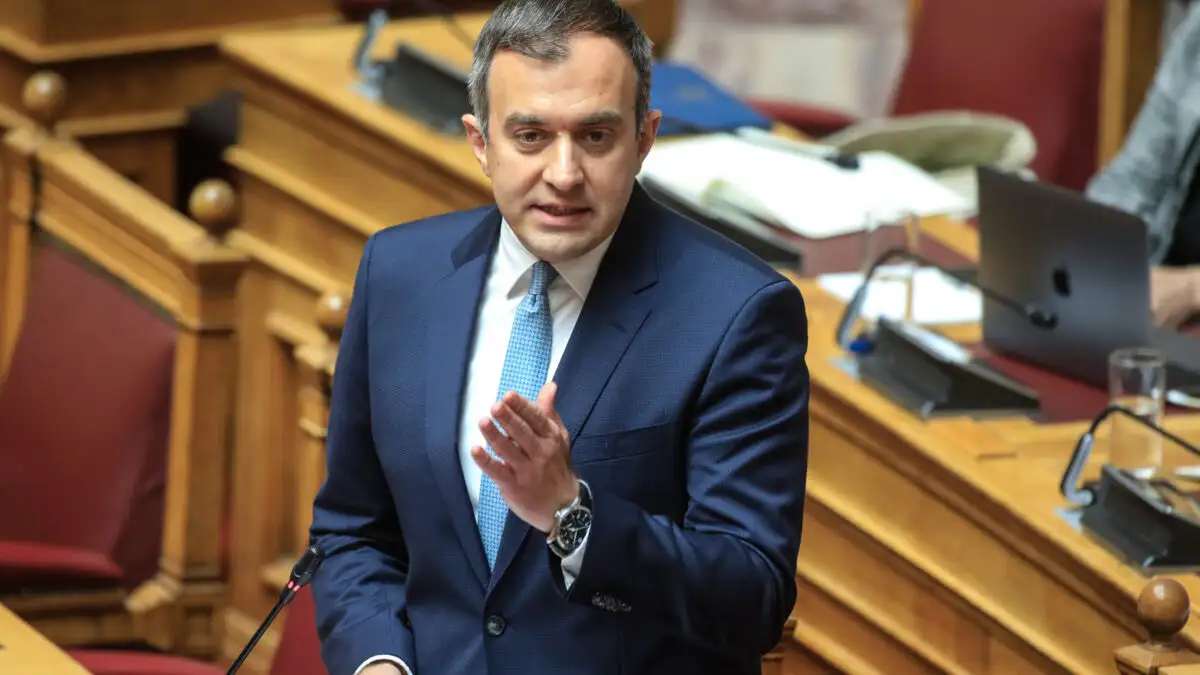
Πηγή Φωτογραφίας: eurokinissi//Chatzivasileiou: Turkey’s Maritime Parks Are “Fake” — Ankara Responds to Greece With Illegality



Greece sent a firm message to Ankara on Wednesday as Deputy Foreign Minister Tasos Chatzivasileiou challenged Turkey’s latest maritime initiatives and rejected any suggestion that Athens could accept Turkish jurisdiction over infrastructure projects in the Eastern Mediterranean.
Speaking on SKAI, Chatzivasileiou used unusually sharp language to describe Turkey’s recently announced maritime parks.
“I consider these maritime parks to be fake,” he said.
He then explained why Athens believes Ankara’s move goes beyond environmental policy and forms part of a broader effort to project Turkish claims in the Aegean and Eastern Mediterranean.
“You cannot establish a national maritime park in international waters. Under international law, a national maritime park concerns your territorial waters.”
“Turkey has an à la turca interpretation of international law”
Chatzivasileiou argued that Ankara is attempting to present areas in international waters as though they fall under Turkish national jurisdiction.
“Turkey has an à la turca interpretation of international law and presents supposed national parks in areas that are international waters,” he said.
For Athens, this distinction is central.
The Turkish announcements are not being treated merely as an environmental initiative. Greece sees them within the broader context of Ankara’s maritime claims and its attempt to establish those claims through maps and coordinates.
Why is Turkey moving now?
Chatzivasileiou also questioned the timing and substance of Ankara’s initiative.
“Why did Turkey appear at this particular moment and hastily present what it calls national maritime parks, essentially showing us coordinates?”
He pointed to what Athens considers a striking lack of clarity about their actual environmental purpose.
“Nobody has yet understood what these parks will actually contain, which activities will be restricted or prohibited for ecological reasons. We know none of that.”
His argument was that the environmental substance remains unclear while the geopolitical significance of publishing coordinates is much more apparent.
“It responds with illegality to lawful Greek initiatives”
The deputy foreign minister then delivered the central political argument behind Athens’ position.
“Why did it do this? Because it is responding with an illegality to lawful Greek initiatives,” Chatzivasileiou said.
He contrasted Turkey’s actions with measures already taken by Greece.
“This government was the one that designed the Maritime Spatial Plan,” he said.
And he continued:
“We mapped the outer limits of our continental shelf on a European map bearing the seal of the European Union. We presented national maritime parks within territorial waters, precisely as international law provides.”
The government’s position is therefore built around a fundamental distinction: Greece argues that it is acting within international and European legal frameworks, while Turkey is responding through unilateral claims.
The second front: The Great Sea Interconnector
The discussion on SKAI went well beyond maritime parks.
Chatzivasileiou also addressed the Great Sea Interconnector, the strategic electricity link designed to connect Greece, Cyprus and Israel.
His message was unequivocal:
“Planning for the cable is proceeding normally.”
He also rejected the proposition that Greece requires Turkish permission to proceed with the infrastructure project.
“Under international law, permission is not required for an infrastructure project, particularly for a peaceful infrastructure project,” he said.
For Athens, the project extends far beyond a bilateral Greek-Turkish dispute.
The cable is designed to end Cyprus’ energy isolation and ultimately connect Europe electrically with the Middle East.
“This is not a Greek, Cypriot or Israeli project,” Chatzivasileiou stressed, describing it as a European project with much broader strategic significance.
Meridiam’s entry is “a vote of confidence” in ADMIE
Chatzivasileiou also highlighted the involvement of French infrastructure investor Meridiam, presenting its participation as strategically important for both the project and Greece’s Independent Power Transmission Operator, ADMIE.
“The arrival of the French giant Meridiam and its participation in this project constitutes a vote of confidence both in the project itself and in ADMIE, which essentially bears the technical responsibility for this infrastructure,” he said.
He went further:
“Ultimately, to be absolutely clear, Meridiam’s entry into the project means that this project is secure.”
The reference adds another dimension to the geopolitical equation.
The project is not merely backed by Greece and Cyprus. It now carries a stronger European investment and strategic footprint.
“Turkey’s position on the cable is linked to the illegal Turkey-Libya memorandum”
One of Chatzivasileiou’s most significant interventions was his explicit connection between Ankara’s objections to the cable and the Turkey-Libya maritime memorandum.
“Turkey’s position on the cable is linked to the illegal Turkey-Libya memorandum. That is the heart of the matter,” he said.
He then posed a pointed question:
“Is there anyone who recognises the Turkey-Libya memorandum and its provisions apart from Turkey?”
Chatzivasileiou recalled that Greece responded to the Turkey-Libya agreement through its own maritime delimitation agreement with Egypt.
“We did not sit back and watch the Turks design an illegal memorandum. We responded with a lawful delimitation agreement with Egypt, in order to show our neighbours how neighbouring states should cooperate and how outstanding issues should be resolved.”
“Greece will not back down”
Asked how far the dispute could go, Chatzivasileiou remained cautious about escalation but categorical about Greece’s position.
“Greece will not leave any political challenge unanswered and will not back down on any issue concerning its national interest and sovereign rights. Full stop.”
He later reiterated that the cable project remains on track.
“The planning is here. It is proceeding normally.”
And his message on the handling of the situation was equally deliberate:
“Calm and patience. Everything will happen in the proper way and at the proper time.”
Chatzivasileiou hits back at the opposition
The interview also developed into a domestic political confrontation when Chatzivasileiou was asked about opposition accusations that the government has been overly accommodating towards Turkey.
He rejected that argument outright.
“The narrative about retreat is completely false,” he said.
Chatzivasileiou then listed what he sees as evidence of the government’s record:
“I want them to tell me where exactly the retreat is. In the EEZ agreements with Italy and Egypt? In the extension to 12 nautical miles in the Ionian Sea? In the agreements? In the Maritime Spatial Plan? Where exactly is this government supposedly being submissive?”
His criticism of the opposition became even sharper:
“Enough with populism. Enough with cheap criticism.”
He concluded with a call for greater political responsibility on national issues.
“These issues are extremely serious. They are matters of national importance, and all political forces should be twice as careful when taking a position on them.”
Maritime parks, the cable and the Turkey-Libya deal are pieces of the same geopolitical puzzle
The significance of Chatzivasileiou’s intervention becomes clearer when the different issues are considered together.
Athens is not treating Turkey’s maritime parks, its objections to the Great Sea Interconnector and the Turkey-Libya memorandum as isolated episodes.
It increasingly views them as different manifestations of the same Turkish strategy: an attempt to consolidate maritime claims through maps, coordinates and demands for “coordination” that Greece argues have no basis in international law.
Athens is seeking to answer on a fundamentally different terrain — through maritime delimitation agreements, an EU-backed Maritime Spatial Plan, national maritime parks based on territorial waters and strategic energy interconnections carrying a wider European footprint.
The phrase “fake maritime parks” may be the most eye-catching line from Wednesday’s interview.
But the deeper message from Athens is more consequential: Greece will not accept a Turkish maritime claim in practice simply because Ankara has drawn it on a map.
Source: pagenews.gr
Διαβάστε όλες τις τελευταίες Ειδήσεις από την Ελλάδα και τον Κόσμο