Trump Leaves Netanyahu Exposed on West Bank: White House Didn’t Block Sanctions by 12 Western Countries
 ΧΡΟΝΟΣ ΑΝΑΓΝΩΣΗΣ 6 '
Πηγή Φωτογραφίας: AP Photo//Trump Leaves Netanyahu Exposed on West Bank: White House Didn’t Block Sanctions by 12 Western Countries



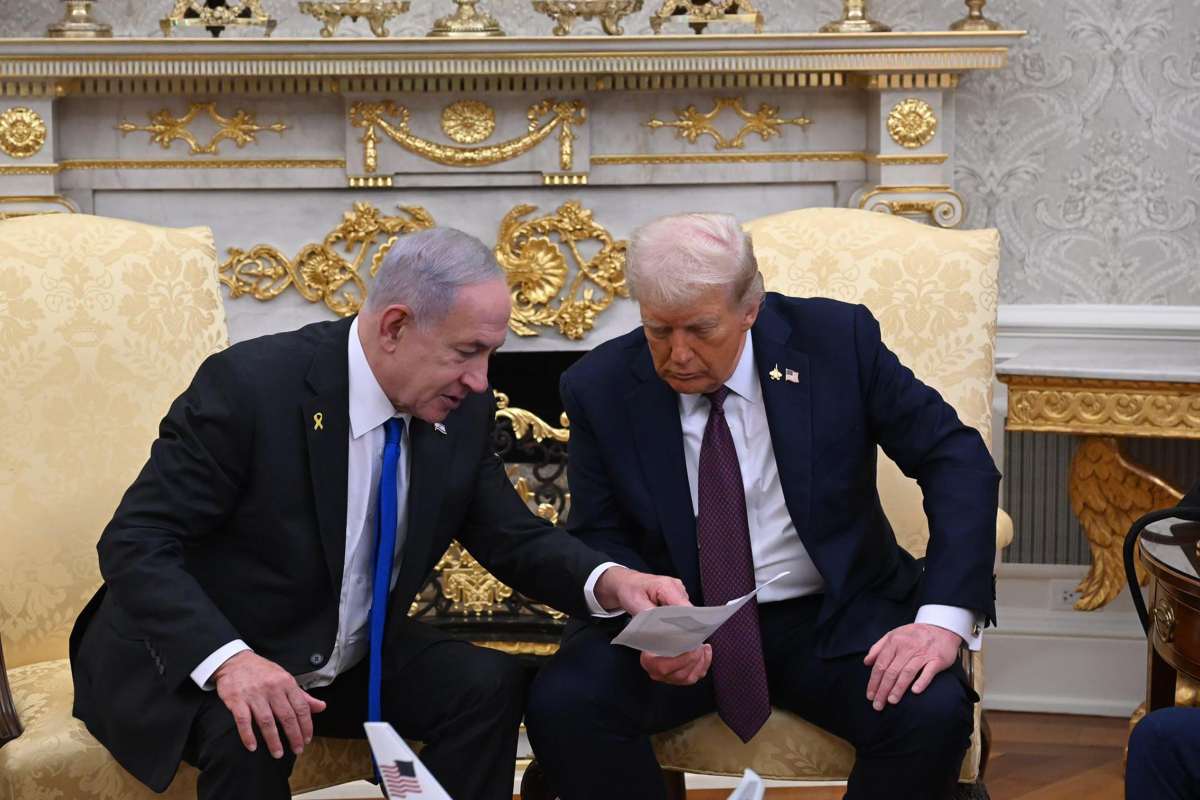
A new fault line is opening between Washington and Jerusalem — not through a dramatic public clash, but through something potentially more revealing: the White House choosing not to intervene.
The Trump administration did not oppose a UK-led initiative to impose sanctions on individuals and entities involved in Israeli settlement activity in the occupied West Bank, even as 11 other Western countries joined the move.
According to Axios, that posture reflects mounting U.S. concern over the Netanyahu government’s policies in the West Bank and, in particular, its decision to move forward with settlement construction in the highly sensitive E1 area.
The move that changes the tone in U.S.-Israel relations
The United Kingdom announced sanctions on individuals and entities linked to settlement expansion, as well as restrictions on goods imported from Israeli settlements.
Canada, Denmark, Finland, France, Iceland, Ireland, Norway, Poland, Portugal, Spain and Sweden joined the UK in declaring their intention to impose national restrictions or support broader European measures targeting trade with settlements in the occupied West Bank.
The trigger was the Netanyahu government’s decision to advance the E1 project — an area east of Jerusalem that Western governments argue would damage territorial continuity in any future Palestinian state.
Successive Republican and Democratic administrations in Washington have opposed construction in E1.
Trump was briefed in advance — and did not push back
The most significant part of the story is what happened behind the scenes.
British Prime Minister Andy Burnham briefed President Donald Trump before the sanctions were announced.
According to people familiar with the conversation, Trump did not press Burnham to change course and did not ask the British government to abandon the initiative.
U.S. officials also told their British counterparts that Washington shared concerns about Netanyahu’s policy in the West Bank, even if it disagreed with the specific use of sanctions.
That distinction matters.
The United States did not join the sanctions.
But it did not fight them either.
And in a relationship where Washington has often served as Israel’s most powerful diplomatic shield, that neutrality sends a message of its own.

Rubio avoids condemning the UK move
Secretary of State Marco Rubio also declined to publicly condemn the British decision.
“The President hasn’t commented on this and neither have I. We were made aware that they are gonna make this decision. We heard their arguments as to why,” Rubio said.
He added:
“We share the goal of stability. We don’t want to see an uptick in violence or tensions in the West Bank in a tenuous time in the region.”
The language is notable because it neither backs the sanctions nor rushes to defend the Israeli government.
Instead, Rubio shifted the focus toward preventing further escalation in the West Bank.
The White House distances itself from Huckabee
An even more striking signal came after comments by U.S. Ambassador to Israel Mike Huckabee.
Huckabee sharply attacked the British sanctions and described them as discriminatory against the Jewish people.
But the White House quickly made clear that his remarks had not been coordinated with either the administration or the State Department.
That is politically significant.
The U.S. ambassador in Israel took a strongly pro-Israel position — and the Trump administration itself chose to distance Washington from it.
Why E1 matters so much
The E1 area is one of the most sensitive settlement zones in the West Bank.
Western governments argue that large-scale development there would make the geographic continuity of a future Palestinian state far harder to achieve.
That is why the issue has repeatedly triggered international opposition.
For years, E1 has functioned as a red line not only for European governments but also for Washington.
The current dispute therefore goes beyond settlement policy.
It touches the larger question of whether the two-state framework remains viable at all.
Netanyahu responds with diplomatic retaliation
The Israeli government reacted forcefully to the sanctions.
According to Axios, it announced the closure of the UK consulate in East Jerusalem, which handles relations with the Palestinian Authority.
Israel also expelled British diplomats and military personnel serving in a U.S.-led Gaza task force and ended a British military training mission in the West Bank.
The response underlines how seriously Netanyahu’s government views coordinated Western pressure over settlement policy.
Is Washington changing course — or issuing a warning?
It would still be premature to describe this as a fundamental shift in U.S. policy toward Israel.
The Trump administration continues to see Israel as a core strategic ally.
Washington’s broader Middle East policy remains heavily focused on Iran, regional security and maintaining a U.S.-aligned architecture across the region.
But the tone is changing.
The White House appears increasingly willing to let European governments pressure Netanyahu over the West Bank without immediately using American political weight to stop them.
That matters.
Trump is separating support for Israel from automatic support for Netanyahu
The most important political reading is that Trump appears to be drawing a distinction between the U.S.-Israel strategic alliance and unconditional backing for every policy pursued by Netanyahu’s government.
That is especially relevant in the West Bank, where continued settlement expansion risks triggering more violence and further weakening the prospect of a political settlement.
For Netanyahu, the message is uncomfortable:
Israel remains a strategic ally of the United States — but the Israeli government can no longer assume that Washington will automatically shield every decision it makes.
If this posture continues, settlement policy could become one of the first serious areas of sustained tension between Trump and Netanyahu.
Source: pagenews.gr
Διαβάστε όλες τις τελευταίες Ειδήσεις από την Ελλάδα και τον Κόσμο