ALCO Poll: New Political Landscape Emerges as New Democracy Leads, Tsipras Returns, and PASOK Slides
 ΧΡΟΝΟΣ ΑΝΑΓΝΩΣΗΣ 5 '
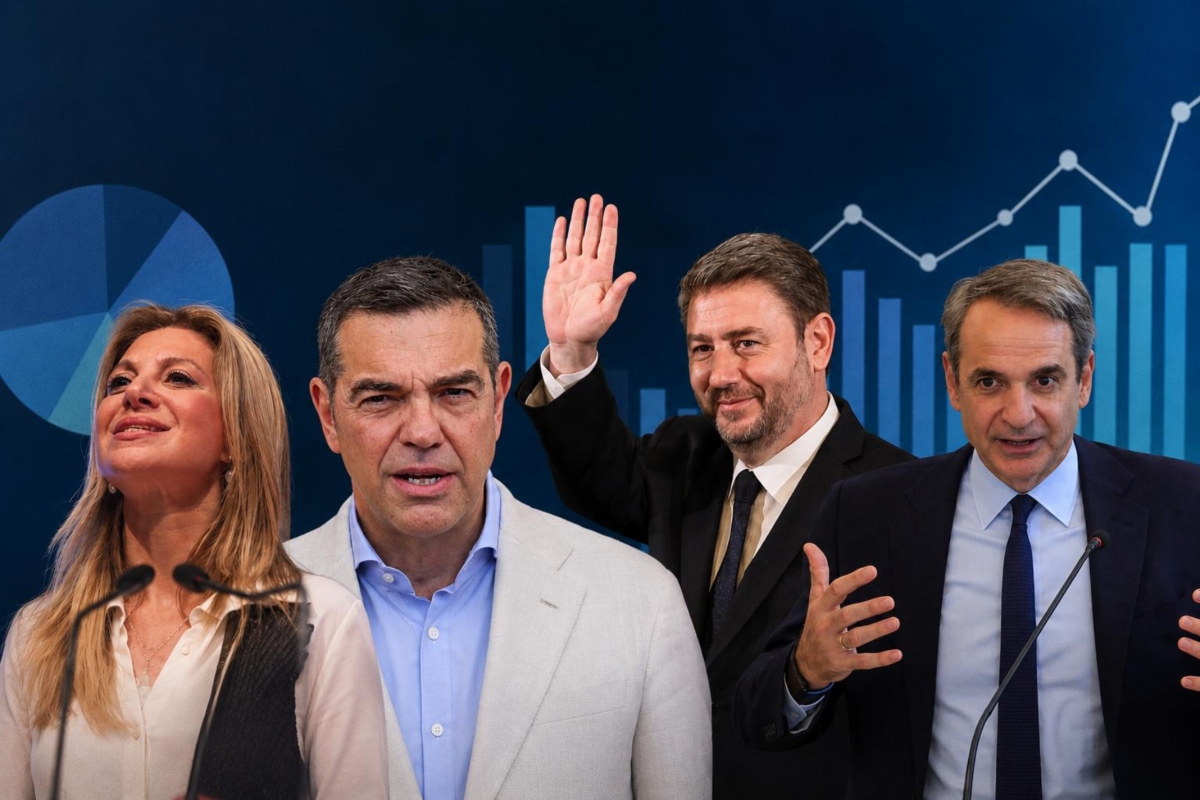
Πηγή Φωτογραφίας: creative team pagenews.gr//ALCO Poll: New Political Landscape Emerges as New Democracy Leads, Tsipras Returns, and PASOK Slides



New Democracy Remains First, Tsipras’ E.L.A.S. Takes Second Place
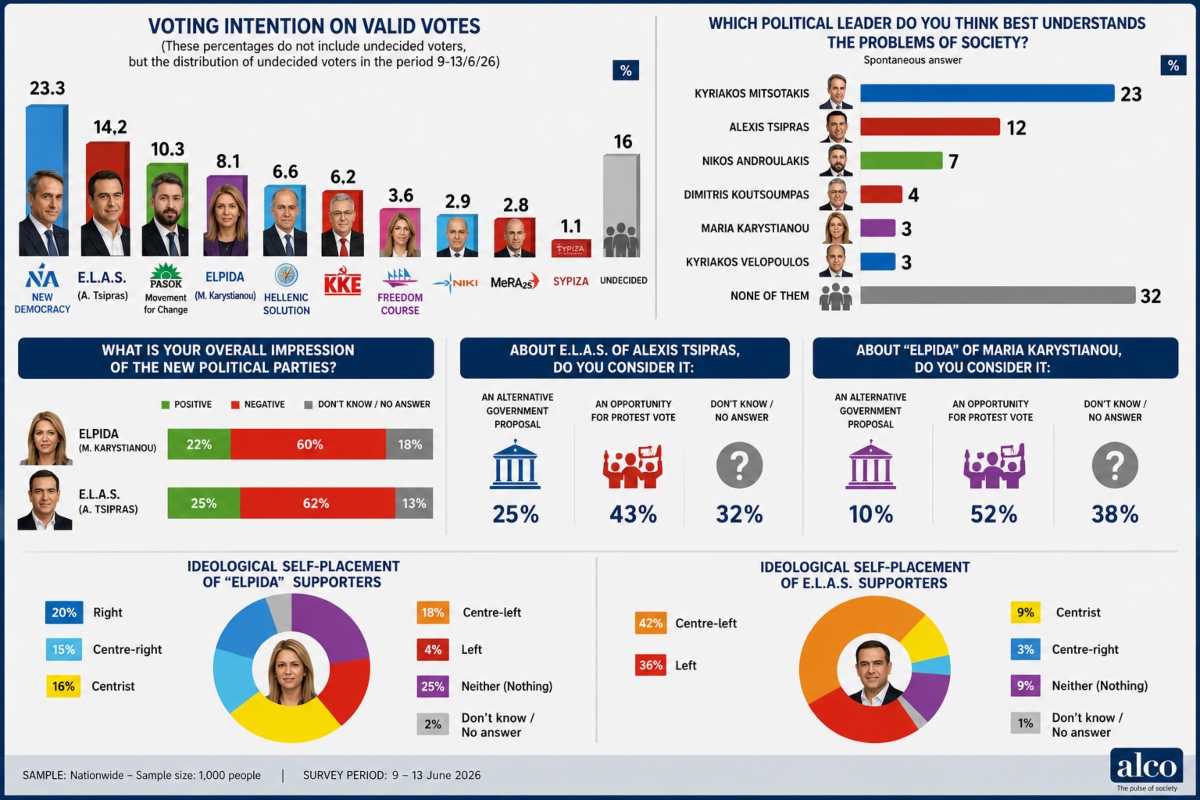
According to the poll, New Democracy (ND) remains the strongest political force, recording 23.3% in voting intention, slightly up from 22.8% in May.
The most notable development is the strong debut of E.L.A.S. (Hellenic Left Alliance), the new political movement led by former Prime Minister Alexis Tsipras, which secures 14.2%, comfortably occupying second place.
PASOK falls to 10.3%, losing nearly two percentage points compared to the previous month and finding itself almost four points behind Tsipras’ new formation.
Voting Intention (Valid Votes)
- New Democracy: 23.3%
- E.L.A.S. (Alexis Tsipras): 14.2%
- PASOK: 10.3%
- Hope for Democracy (Maria Karystianou): 8.1%
- Greek Solution: 6.6%
- Communist Party (KKE): 6.2%
- Course of Freedom: 3.6%
- NIKI: 2.9%
- MeRA25: 2.8%
- SYRIZA: 1.1%
- Undecided: 16%
Statistical Analysis
The poll indicates that New Democracy maintains a lead of more than nine percentage points over its nearest rival.
Meanwhile, E.L.A.S. appears to be drawing support primarily from former SYRIZA voters, disillusioned PASOK supporters, and portions of the broader center-left electorate.
PASOK records the steepest decline of any major party, suggesting that Tsipras’ return has significantly reshaped the opposition landscape.
Which Political Leader Best Understands Society’s Problems?
One of the most revealing findings concerns public perceptions of political leadership.
Responses
- None of the above: 32%
- Kyriakos Mitsotakis: 23%
- Alexis Tsipras: 12%
- Nikos Androulakis: 7%
- Dimitris Koutsoumbas: 4%
- Maria Karystianou: 3%
- Kyriakos Velopoulos: 3%
What the Numbers Show
The most striking result is not Mitsotakis’ first-place ranking.
Instead, it is the fact that 32% of respondents answered “none”, reflecting a deep crisis of confidence in Greece’s political leadership as a whole.
Prime Minister Kyriakos Mitsotakis remains the most trusted figure on this metric, leading Tsipras by eleven points.
However, Alexis Tsipras’ immediate rise to second place demonstrates that he still retains substantial political influence despite years away from frontline politics.
First Impressions of the New Political Parties
The survey also measured public attitudes toward the two major new political projects: Tsipras’ E.L.A.S. and Maria Karystianou’s Hope for Democracy.
Hope for Democracy
- Positive impressions: 22%
- Negative impressions: 60%
- No opinion: 18%
E.L.A.S.
- Positive impressions: 25%
- Negative impressions: 62%
- No opinion: 13%
Interpretation
Both parties currently face more negative than positive reactions among the broader electorate.
However, E.L.A.S. enjoys slightly stronger positive ratings than Hope for Democracy, while a significant portion of voters remain undecided, indicating that perceptions have not yet fully crystallized.
Is E.L.A.S. a Governing Alternative or a Protest Movement?
Respondents were asked whether Tsipras’ new movement represents a genuine governing alternative.
Responses
- Protest vote vehicle: 43%
- Alternative governing proposal: 25%
- Undecided: 32%
While one-quarter of respondents already view E.L.A.S. as a potential governing force, the plurality still sees it primarily as an instrument of political protest.
This suggests that Tsipras has succeeded in rebuilding opposition momentum but has not yet convinced a majority of voters that his new project is ready to govern.
Maria Karystianou’s “Hope” and the Protest Vote Phenomenon
The results are even clearer for Maria Karystianou’s movement.
Responses
- Protest vote opportunity: 52%
- Alternative governing proposal: 10%
- No opinion: 38%
Interpretation
The party’s support appears to be driven primarily by public dissatisfaction with the political establishment rather than by a fully developed policy platform.
Only one in ten respondents currently sees the movement as a realistic governing alternative.
Who Supports Hope for Democracy?
The ideological profile of Karystianou’s supporters reveals an unusually broad coalition.
Self-Identification of Supporters
- Right-wing: 20%
- Center-right: 15%
- Centrists: 16%
- Center-left: 18%
- Left-wing: 4%
- None: 25%
- No answer: 2%
Key Finding
The largest group consists of voters who reject traditional ideological labels altogether.
At the same time, the movement appears to draw significantly more support from center-right and right-wing voters than from the traditional left.
Who Supports Alexis Tsipras’ E.L.A.S.?
The ideological composition of E.L.A.S. voters is far more concentrated.
Self-Identification of Supporters
- Center-left: 42%
- Left-wing: 36%
- Centrists: 9%
- None: 9%
- Center-right: 3%
- No answer: 1%
Analysis
The data suggests that Tsipras has successfully reunited much of Greece’s fragmented progressive electorate.
Nearly 80% of E.L.A.S. supporters identify as either center-left or left-wing, confirming the movement’s dominance within the broader progressive political space.
The Bigger Political Picture
The ALCO poll points to three major political trends:
1. New Democracy Remains Dominant
Despite signs of voter fatigue after years in government, New Democracy continues to lead comfortably and Kyriakos Mitsotakis remains the country’s strongest political figure.
2. Alexis Tsipras Has Re-Emerged as the Main Opposition Force
E.L.A.S. has rapidly established itself as the primary challenger on the center-left, drawing support from former SYRIZA voters and significant portions of PASOK’s electorate.
3. Anti-Establishment Sentiment Remains Strong
The success of both E.L.A.S. and Hope for Democracy reflects widespread voter frustration with traditional politics.
This is further reinforced by the fact that nearly one-third of respondents believe no political leader truly understands the problems facing society.
The coming months are likely to determine whether these new political formations can transform protest energy into credible governing platforms.
For now, New Democracy remains firmly in control, Alexis Tsipras has re-established himself as the leading opposition figure, and Greece’s political system appears to be entering a new period of realignment and uncertainty.
Source: pagenews.gr
Διαβάστε όλες τις τελευταίες Ειδήσεις από την Ελλάδα και τον Κόσμο