Constitution on the Edge of 180 Votes: The Ballot That Could Reshape Greece’s 2027 Election
 ΧΡΟΝΟΣ ΑΝΑΓΝΩΣΗΣ 23 '
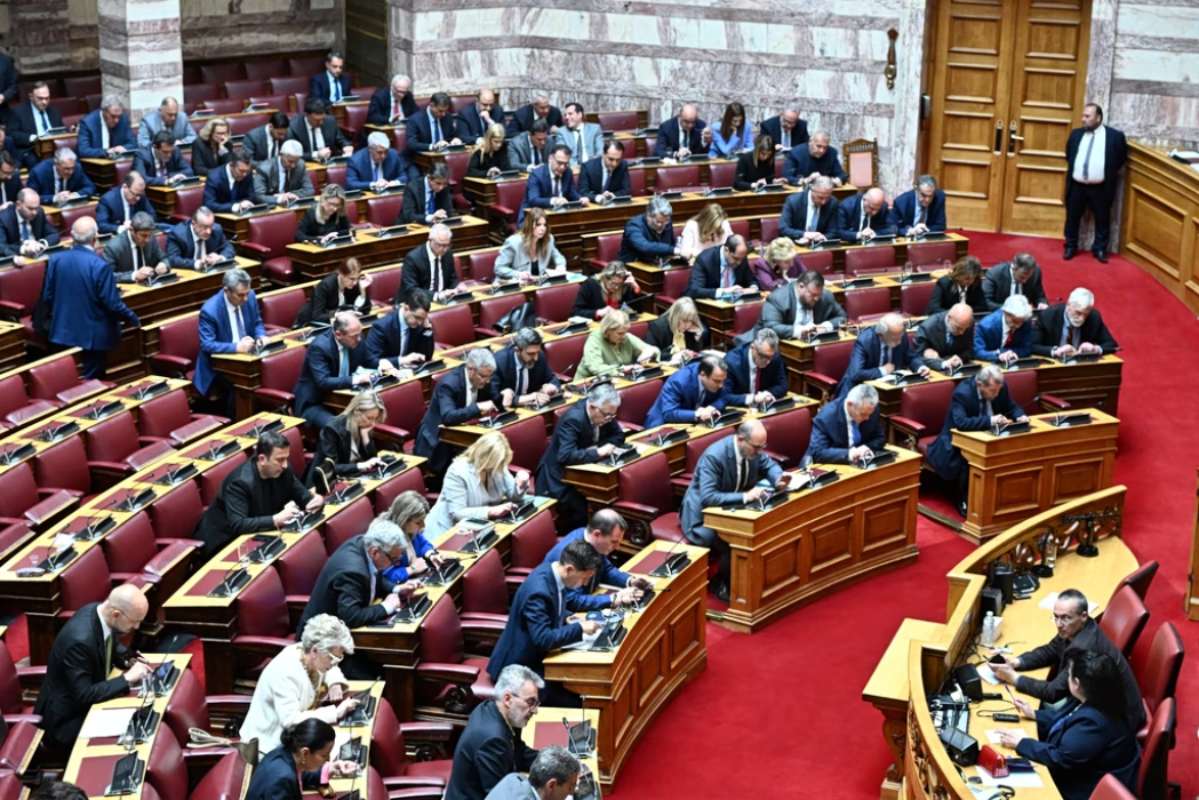
Πηγή Φωτογραφίας: eurokinissi//Constitution on the Edge of 180 Votes: The Ballot That Could Reshape Greece’s 2027 Election



The First Major Test of the Constitutional Revision
Greece’s constitutional revision process enters its first decisive parliamentary phase on Monday, July 27, 2026, as the plenary session votes on which of the 33 articles and constitutional provisions included in New Democracy’s proposal should formally be declared open to revision.
The electronic, roll-call and public vote is scheduled to begin shortly after 6 p.m., following extensive debate in Parliament and the earlier proceedings of the Constitutional Revision Committee.
On paper, this is a strictly regulated institutional procedure.
In political terms, however, the vote is far more consequential.
It is the first formal measurement of the parliamentary alignments that could shape Greece’s next political cycle.
Every “yes,” “no” and “present” vote will concern not only the wording of a constitutional provision, but also the ability of political parties to cooperate, the areas in which future consensus may be possible and, above all, how much freedom the next Parliament will have to determine the final content of the revision.
The Battle of 151 and 180 Votes
The key to the entire process lies in Article 110 of the Greek Constitution, which establishes a revision procedure involving two consecutive Parliaments.
The current Parliament does not determine the final wording of the revised provisions.
It decides only which constitutional articles should be amended.
The final content will be drafted by the next Parliament, following the national election.
The voting thresholds, however, are crucial.
If a provision receives at least 180 votes in the current Parliament, the next revisionary Parliament will need only an absolute majority of 151 MPs to approve its final wording.
If a provision receives between 151 and 179 votes, the next Parliament will need an enhanced majority of 180 MPs to complete the revision.
Any provision that fails to receive at least 151 votes will be removed from the process and will not proceed to the second ballot expected in late August.
This arithmetic transforms the vote into a high-stakes political chessboard.
The Constitutional Paradox
The revision process contains a striking political paradox.
A broader majority today may mean less control for the opposition tomorrow.
If opposition parties help a provision reach 180 votes, the next governing majority may be able to determine its final wording with only 151 MPs.
By contrast, if the provision passes with between 151 and 179 votes, the next Parliament will be forced to seek a much broader consensus of 180 MPs.
Opposition parties therefore face a difficult strategic choice.
Should they vote in favor of a revision they support in principle, while risking giving the next governing majority control over its final content?
Or should they limit their support today, ensuring that no single political bloc will be able to rewrite the Constitution alone after the election?
This is the political logic behind the “present” vote considered or adopted by opposition parties on several sensitive provisions.
It is not necessarily a neutral position.
It may be a deliberate strategy designed to preserve the requirement for a 180-vote majority in the next Parliament.
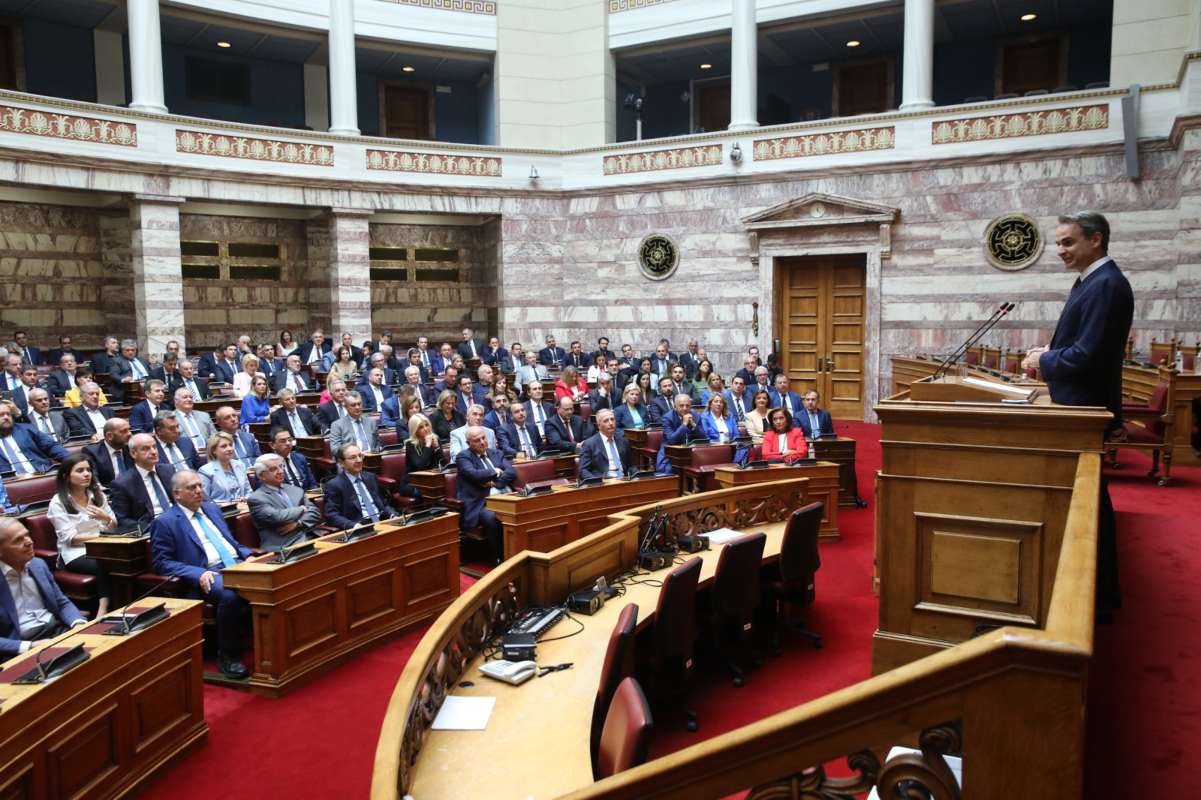
New Democracy’s Political Strategy
New Democracy is presenting the revision as a broad institutional and modernization agenda covering artificial intelligence, climate change, judicial independence, public-sector evaluation, higher education and political stability.
The government’s strategy operates on two levels.
First, Prime Minister Kyriakos Mitsotakis and the governing party want New Democracy to be seen as the political force shaping the institutional framework of Greece for the next decade.
Second, the government is seeking to place the opposition under pressure by forcing it to take clear positions on issues with strong public resonance:
- ministerial accountability,
- public-sector evaluation,
- non-state universities,
- the appointment of senior judges,
- postal voting,
- electoral stability,
- affordable housing,
- climate policy,
- and public-sector transparency.
The government’s argument is straightforward:
“Anyone rejecting the revision must explain what exactly they want to remain unchanged.”
The opposition, however, accuses the government of pursuing a one-party, electorally calculated revision process shortly before the final political stretch leading to the 2027 election.
Article 86: The Heart of the Institutional Conflict
At the center of the political confrontation is Article 86, concerning the criminal liability of ministers.
New Democracy’s proposal provides that preliminary investigations and pretrial proceedings involving current or former ministers would be conducted by senior judicial or prosecutorial authorities rather than by a parliamentary preliminary investigation committee.
However, the final authorization to prosecute a minister or deputy minister would still require a parliamentary decision supported by at least 151 MPs.
The government argues that the proposed system would significantly reduce the partisan character of investigations and transfer the evidentiary process to the judiciary.
PASOK, however, supports the complete removal of Parliament from the prosecution process and proposes that the relevant decision be taken exclusively by a special judicial council.
This is one of the clearest dividing lines in the revision.
The government maintains that Parliament cannot be entirely excluded from a procedure involving actions carried out by ministers in the exercise of public office.
The opposition argues that as long as Parliament retains the final key, party majorities may still shield ministers, trade political favors or instrumentalize investigations.
The dispute is not merely technical.
It directly addresses the public demand for equal accountability for politicians and ordinary citizens.
The Battle Over Non-State Universities
The proposed opening of Greece’s higher-education system to non-state universities carries equally powerful political symbolism.
The central constitutional debate concerns Article 16, which currently provides that higher education is delivered by institutions operating as public-law legal entities.
The government wants to permit universities established by non-state or private legal entities, subject to state supervision, academic independence and strict quality requirements.
For New Democracy, the change is necessary to reduce the flow of students and capital abroad, attract foreign universities and make Greece a regional education hub.
For the Left and a significant part of the opposition, the amendment threatens the public character of higher education and risks creating a multi-tier education system determined by students’ financial means.
PASOK appears to recognize that Greece’s university system requires reform, but insists on stronger guarantees and seeks to avoid complete alignment with the government’s wording.
The issue is therefore not simply whether non-state universities should operate.
The deeper question is who will regulate them, how academic quality will be guaranteed and whether public universities will be strengthened or gradually marginalized.
Public-Sector Evaluation: Social Support and Political Risk
One of the provisions with the greatest potential public appeal is Article 103, concerning civil servants.
The proposal would constitutionally establish mandatory evaluation based on:
- impartiality,
- political neutrality,
- professional competence,
- effectiveness,
- and performance.
It also provides for two-way evaluation, including assessments of managers by their subordinates, performance-related financial rewards and potential consequences that could extend to permanent dismissal following a decision by the competent public-service council.
For the government, Article 103 would create the constitutional foundation for a public administration that rewards competence, identifies dysfunction and does not treat permanent employment as immunity from persistent negligence or underperformance.
For opposition parties and trade unions, however, the most critical issue is not evaluation itself, but the consequences attached to it.
Who will evaluate public employees?
According to which criteria?
Who will evaluate the evaluators?
Will the process be used to improve services, or will it become a mechanism for disciplinary control and dismissals?
The government knows that a broad social majority supports evaluation as a principle.
The opposition knows that outright rejection could make it appear to be defending inertia and inefficiency.
The real political battle will therefore concern the safeguards.
Removing the Government’s Shadow From the Judiciary
The proposed revision of Article 90 seeks to reduce direct government involvement in the appointment of the presidents and vice-presidents of Greece’s highest courts.
Under the proposal, senior judicial appointments would be made by a special parliamentary committee from a shortlist submitted by the plenary bodies of the relevant courts.
The change is intended to address longstanding criticism that the government of the day can influence, or at least appear to influence, the leadership of the judiciary.
Yet transferring the decision from the Cabinet to a parliamentary committee does not automatically eliminate the risk of politicization.
The decisive question is:
What majority will be required within that committee?
If the governing majority can decide alone, the reform may amount to an institutional rearrangement rather than genuine depoliticization.
If broader cross-party agreement is required, the new system could significantly strengthen judicial independence.
Preventive Constitutional Review: A Major Shift in the Balance of Power
The proposed revisions to Articles 77 and 100 introduce preventive constitutional review of legislation after it has been approved by Parliament but before it is formally published and enters into force.
The President of the Republic, the prime minister or Parliament would be able, under certain conditions, to refer an approved bill to the Supreme Special Court.
Legislation involving voting rights and the electoral system would be subject to mandatory review before publication.
This would represent a significant institutional change.
Greece traditionally operates a decentralized system of constitutional review, under which any court may refuse to apply a law it considers unconstitutional.
The new proposal would introduce a powerful centralized mechanism capable of blocking legislation before it takes effect.
Supporters argue that this would prevent legal uncertainty, contradictory court judgments and years of litigation over unconstitutional laws.
Critics warn that the Supreme Special Court could evolve into a de facto Constitutional Court without a sufficiently comprehensive debate on its powers, composition and democratic legitimacy.
The Electoral System and the Constitutionalization of Governability
Through the proposed revision of Article 54, New Democracy seeks to establish that the electoral system must guarantee not only “reasonable proportionality” but also the governability of the country.
The inclusion of governability in the Constitution is not politically neutral.
It could provide constitutional support for electoral systems offering a seat bonus to the first party or other mechanisms designed to facilitate stable majority governments.
For New Democracy, the lesson of previous periods of instability is that the electoral system must allow the country to form viable governments.
For the opposition, however, constitutional recognition of governability may become a permanent instrument for strengthening the first party at the expense of proportional representation.
The provision is directly connected to the future structure of Greece’s party system, at a time when single-party majorities are becoming more difficult and coalition governments may again become unavoidable.
Postal Voting and the Expansion of Electoral Participation
The proposed revision of Article 51 would allow postal voting not only for Greeks living abroad, but also for voters inside the country.
The government presents the reform as a way to make participation easier for:
- elderly citizens,
- people with disabilities,
- seasonal workers,
- voters working far from their registered constituency,
- and citizens facing objective mobility restrictions.
The opposition is calling for strong guarantees regarding ballot secrecy, voter identification and protection from organized pressure or manipulation.
The conflict here concerns less the principle itself than public trust in the process.
Political Parties and Electoral Exclusion
The revision of Article 29 would constitutionally define the conditions governing the establishment and operation of political parties and give the Supreme Special Court authority to decide whether a party is eligible to participate in elections.
The proposal aims to provide a stronger constitutional basis for excluding parties linked to criminal organizations or groups acting against democratic government.
However, the reference to “principles of democratic operation” is likely to generate intense legal debate.
The objective is to protect democracy from organizations seeking to undermine it without creating a vague mechanism that could be used to restrict legitimate political competition.
A Single Six-Year Term for the President
New Democracy proposes replacing the current five-year presidential term, which may be renewed once, with a single six-year term.
The aim is to detach the presidency from the debate over re-election and reduce the risk that a serving president may act with a second term in mind.
Supporters argue that a single term would strengthen the independence and institutional neutrality of the head of state.
Critics contend that six years is a long period and could create an extended mismatch between the President of the Republic and changing parliamentary or political majorities.
Ending Early Elections on the Pretext of a “National Issue”
The proposed amendment to Article 41 would abolish the government’s ability to dissolve Parliament by invoking a national issue of exceptional importance.
Early dissolution would instead require a government proposal and a parliamentary decision to renew the popular mandate.
The provision seeks to eliminate a constitutional formula repeatedly used to justify early elections even when the real motivation was political timing.
Politically, the reform would limit the prime minister’s unilateral ability to choose the election date.
However, because the governing majority would still be able to support a parliamentary decision for dissolution, the government would retain considerable control over the electoral calendar.
Housing, Climate Change and Next-Generation Rights
The revision is not limited to the organization of political power.
The proposed amendment to Article 21 introduces a constitutional obligation for the state to support affordable housing and to consider intergenerational justice when designing public policy.
The proposed expansion of Article 24 includes explicit references to:
- combating climate change,
- managing water resources,
- supporting renewable energy,
- ensuring environmental balance in state interventions,
- and protecting animals.
A proposed new Article 5B would also state that artificial intelligence must serve individual freedom and social well-being while mitigating risks and maximizing benefits.
These provisions carry strong symbolic importance.
Their practical value, however, will depend on whether they create specific, judicially enforceable obligations for the state.
Without such obligations, they risk becoming statements of intent rather than effective constitutional protections.
Tax Stability and Constitutional Fiscal Discipline
The proposed amendments to Articles 78 and 79 seek to:
- prohibit retroactive taxation and other retroactive financial burdens,
- allow stable tax regimes for strategic private investments,
- establish a constitutional obligation for sustainable fiscal management,
- and strengthen the accountability of organizations financed directly or indirectly by the state budget.
The aim is to bring elements of economic policy into the Constitution that are currently governed mainly by ordinary legislation or European fiscal rules.
Supporters argue that the measures would increase legal certainty, improve investment predictability and protect future generations from uncontrolled borrowing.
Critics warn that placing fiscal constraints in the Constitution could unduly restrict the policy choices of future governments, especially during financial or social emergencies.
Local Government Taxation: Reform or New Inequality?
The proposal for Article 102 would allow local authorities to impose local or special taxes and charges.
Fiscal decentralization could increase the autonomy of municipalities and regions, strengthen local accountability and reduce dependence on central-government transfers.
It could also deepen regional inequality.
Wealthy, tourism-intensive or economically strong municipalities would be able to raise significantly more revenue than small, mountainous, island or demographically declining areas.
Without a robust equalization mechanism, fiscal decentralization could widen rather than reduce territorial disparities.
Not All 33 Provisions Carry the Same Political Weight
Although Parliament is voting on dozens of provisions, the central political contest is concentrated around a smaller group of major issues:
- Article 86: Ministerial criminal liability and Parliament’s role.
- Article 16: Non-state universities and the public character of higher education.
- Article 103: Evaluation, permanence and efficiency in the civil service.
- Article 90: Appointment of the leadership of the judiciary.
- Articles 77 and 100: Preventive constitutional review.
- Article 54: The electoral system and the principle of governability.
- Article 51: Postal voting within Greece.
- Article 29: Conditions for political-party participation in elections.
- Article 102: Fiscal autonomy for local government.
- Article 21: Affordable housing and intergenerational justice.
The remaining provisions may attract less attention, but they could become areas for selective consensus and political trade-offs.
PASOK Holds the Key to 180 Votes
Because New Democracy cannot independently reach the enhanced majority of 180 MPs, the greatest political interest focuses on PASOK’s position.
The party must balance three competing priorities.
First, it does not want to appear as a force defending institutional stagnation.
Second, it does not want to give the government the power to determine the final wording of critical provisions with a simple majority in the next Parliament.
Third, it wants to promote its own distinct constitutional agenda, particularly on ministerial accountability, judicial independence, independent authorities and higher education.
Voting “present” on certain provisions allows PASOK to recognize the need for reform without endorsing the government’s proposed direction or abandoning its ability to negotiate after the election.
This position exposes PASOK to pressure from both sides.
New Democracy will accuse it of avoiding clear answers.
The Left will accuse it of leaving open the possibility of future cooperation with the governing party.
In parliamentary terms, however, the strategy aims to preserve PASOK’s position as the indispensable mediator.
A Rehearsal for Future Governing Alliances
The vote will also be interpreted as an informal rehearsal for Greece’s post-election political geometry.
Voting together on a constitutional article does not automatically mean that two parties are preparing a coalition.
But the revision process reveals:
- which parties can cooperate on the functioning of the state,
- where policy convergence exists,
- which issues constitute absolute red lines,
- and which combinations can produce a majority of 180 MPs.
In an increasingly fragmented party system, this information has significant political value.
The next Parliament may not produce an easy single-party majority.
As a result, the alliances required to revise the Constitution may resemble those eventually needed to form or sustain a government.
The Political Risk for the Government
The government is investing heavily in the image of a major reform initiative.
There is, however, a reverse risk.
If most provisions are approved only by New Democracy or by narrow majorities slightly above 151, the opposition will argue that the revision lacks the broad political and social legitimacy appropriate for changes to the country’s fundamental law.
If many provisions reach 180 votes, the government will be able to claim success in building consensus.
At the same time, however, it will need to prove that it did not seek 180 votes merely to give the next parliamentary majority greater freedom to write the final provisions alone.
The Political Risk for the Opposition
The opposition risks becoming trapped between denunciation and responsibility.
Rejecting the entire revision process may satisfy core party audiences, but it does not easily address public demands for:
- reform of ministerial accountability,
- a faster and more independent judiciary,
- evaluation in the public sector,
- greater accountability,
- housing protection,
- and modern constitutional rules for technology and the environment.
Yet uncritical support for the government’s proposals could blur political differences and allow New Democracy to claim ownership of a broad consensus reform.
The opposition’s central challenge is therefore to distinguish clearly between support for the need for change and support for the government’s preferred wording and direction.
The Second Vote and the August Milestone
The first ballot will not complete the current parliamentary stage of the revision.
Article 110 requires a second vote after at least one month.
That ballot is expected during the final week of August and will include only the provisions that receive at least 151 votes in the first round.
The final thresholds will depend on the results of both votes in the current Parliament.
The August vote will therefore not be a procedural repetition.
It will be the second round of a process in which every party will have measured:
- internal dissent,
- social reaction,
- political cost,
- and the behavior of potential post-election partners.
What to Watch in the Vote
The most important information will not come only from whether each provision passes the 151-vote threshold.
Five indicators will reveal the real political picture.
1. Which provisions approach or exceed 180 votes
These will identify the genuine areas of cross-party consensus.
2. Where PASOK votes “yes” and where it votes “present”
Its choices will reveal which areas it considers mature for agreement and which it wants to reserve for negotiation in the next Parliament.
3. Whether New Democracy records internal dissent
Any deviation within the governing party would show that even its own MPs do not fully agree on all aspects of the constitutional agenda.
4. Which provisions fall below 151
Any article failing to reach the threshold will be removed from the current revision cycle.
5. Where unexpected coalitions emerge
Housing, climate policy, animal protection and artificial intelligence may create different parliamentary combinations from those seen on ministerial responsibility, justice or universities.
The Decisive Battle Will Follow the Election
The current Parliament is opening the door to constitutional change.
The next Parliament will decide what lies behind it.
That is why the revision is inseparably linked to the 2027 national election.
The composition of the next Parliament will determine:
- whether New Democracy can impose its preferred direction on provisions that receive 180 votes now,
- whether cooperation with PASOK or other parties will be required,
- whether the opposition can block or rewrite major reforms,
- and whether the final revision will be broad or limited.
In this sense, the Constitution itself becomes part of the electoral stakes.
Citizens will not be voting only for a government.
They will also be deciding, indirectly, which political force will have the leading role in drafting Greece’s new constitutional framework.
The Hour of Real Political Answers
The vote will not produce the final revised Constitution.
It will reveal, however, which parties genuinely want change, in which direction and with which potential allies.
New Democracy wants to present itself as the country’s leading reformist force and to move as many provisions as possible into the next Parliament with the favorable 180-vote threshold.
The opposition wants to avoid giving the government a blank cheque without appearing hostile to reforms that enjoy significant public support.
PASOK is seeking the role of institutional arbiter.
The Left is attempting to block changes it believes would weaken the welfare state, public education and proportional political representation.
And the entire political system understands that today’s voting figures may become tomorrow’s governing alignments.
The evening roll-call vote therefore concerns much more than 33 constitutional provisions.
It concerns who will have the power to write the rules governing Greece for the next decade.
Διαβάστε όλες τις τελευταίες Ειδήσεις από την Ελλάδα και τον Κόσμο