Alpha–UniCredit: Psaltis’ Blueprint for Greek Business – “Scale Up and Go European”
 ΧΡΟΝΟΣ ΑΝΑΓΝΩΣΗΣ 7 '

Πηγή Φωτογραφίας: EUROKINISSI/Alpha–UniCredit: Psaltis’ Blueprint for Greek Business – “Scale Up and Go European”



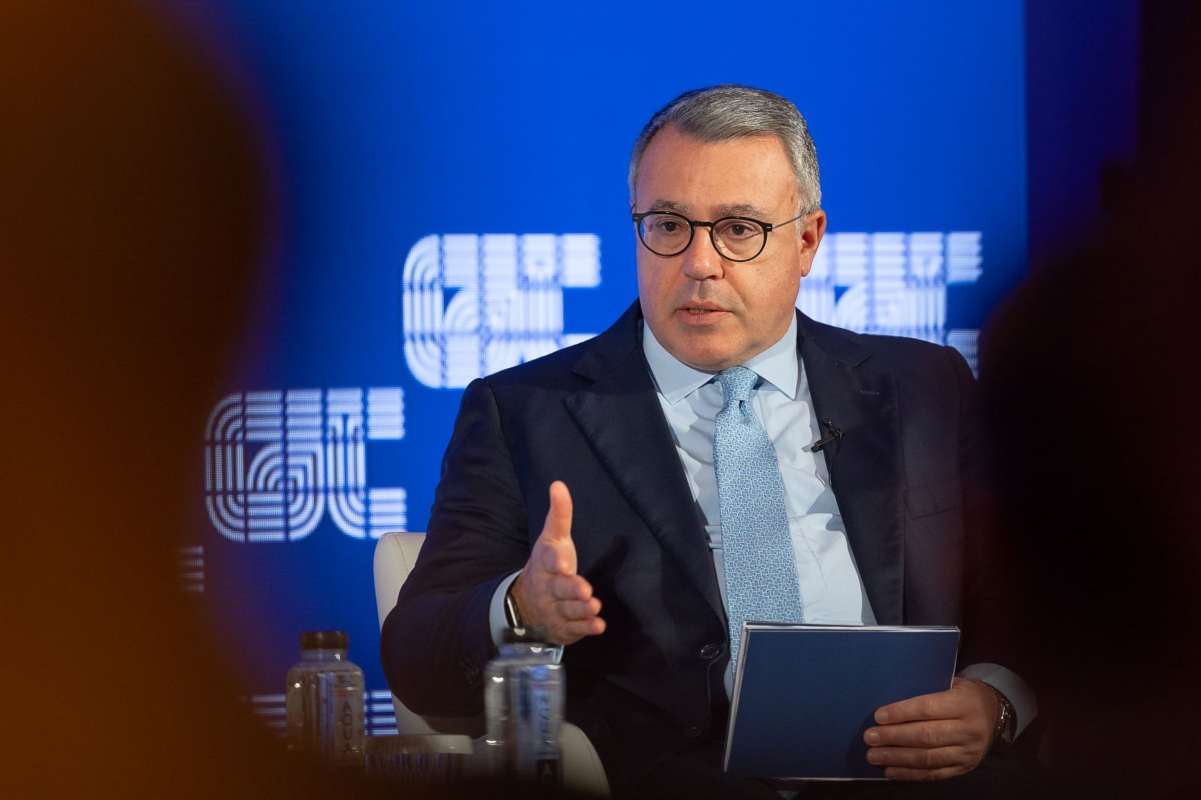
A different model for the next phase of Greek business was outlined by Alpha Bank CEO Vassilis Psaltis at the Hellenic Capital Market Commission’s Annual Symposium 2026.
His central message goes far beyond banking.
Greek companies, he argued, can draw lessons from the transformation of the country’s banking system itself: strengthen their balance sheets, build scale, improve corporate governance and connect much more actively with European pools of capital.
And as a concrete example of that philosophy, Psaltis pointed to Alpha Bank’s strategic partnership with UniCredit.
From repairing balance sheets to financing growth
Psaltis began with the transformation of Greece’s banking sector.
“We moved from repairing bank balance sheets to supporting the recovery of the economy’s productive fabric, with an emphasis on growth, technology and sustainability,” he said.
According to the Alpha Bank CEO, one of the most important lessons for Greek companies is the value of capital resilience.
Equity should not simply be viewed as a defensive instrument deployed during a crisis.
It should be part of the company’s growth strategy.

Psaltis: Equity is not an emergency solution
Psaltis placed particular emphasis on stronger corporate capital structures.
“Equity is not an emergency solution when debt financing has been exhausted. It is an instrument for growth, risk absorption and strategic flexibility,” he said.
That argument has particular relevance for an economy where corporate financing has traditionally remained heavily bank-centric.
The next stage, according to Psaltis, requires deeper capital markets capable of enabling more companies to finance large-scale investment, innovation and international expansion.
The message to companies: Don’t rely on bank loans alone
This was one of the most important elements of his intervention.
The head of one of Greece’s largest banks effectively argued that healthy businesses should not rely exclusively on bank lending.
“Bank lending, corporate bonds, equity capital increases and strategic transactions are complementary instruments that should be used according to each company’s stage of development and needs,” Psaltis said.
The implication is significant.
Greek business needs to move beyond a simple “bank loan” financing model toward a broader capital structure capable of supporting faster and larger growth.
Alpha–UniCredit: A bridge into Europe
This is where UniCredit enters the equation.
Psaltis presented Alpha Bank’s strategic relationship with the Italian banking group as an example of what Greek businesses can achieve by combining financial strength, partnerships and international networks.
“Our partnership with UniCredit creates a meaningful bridge between markets, companies and investors, expanding both our own access and that of our clients to European capital and expertise,” he said.
He then broadened the message to Greek companies:
“This partnership can serve as a model for other Greek businesses: stronger balance sheets, better governance, greater scale, greater international orientation and active connections to European capital networks.”
Scale is the real challenge
Behind that message lies one of the structural challenges facing the Greek economy: the relatively small size of much of its corporate base.
Large investments, technological transformation and international expansion require more than cheaper borrowing.
They require companies with stronger balance sheets, access to multiple sources of capital and sufficient scale to operate beyond the domestic market.
In that sense, the Alpha–UniCredit relationship represents more than a banking transaction.
It illustrates a broader corporate strategy: partner internationally in order to grow internationally.
Corporate governance becomes a passport to capital
Psaltis also focused heavily on corporate governance.
“Corporate governance is not a compliance cost. It is investment infrastructure,” he said.
International investors do not evaluate a company solely on its business plan or earnings outlook.
They also examine transparency, internal controls, risk management and predictability.
“Investment capital flows where there is transparency, credibility and predictability,” Psaltis stressed.
The stronger a company’s governance, therefore, the easier its access to institutional investors and growth capital becomes.
For Greek businesses seeking international funding, governance is increasingly becoming a competitive advantage rather than merely a regulatory obligation.
Europe’s paradox: Plenty of savings, not enough productive investment
Psaltis then widened the discussion to the European level and the Savings and Investments Union.
Europe has substantial private wealth and savings.
Its problem is that it still lacks sufficiently efficient mechanisms to channel enough of that money toward productive European investment.
The answer, according to Psaltis, is not a choice between banks and capital markets.
“We need both,” he said.
Banks remain essential because of their credit-assessment capabilities and their role in financing companies with predictable cash flows. Capital markets, meanwhile, are crucial for raising equity, financing innovation and distributing risk more efficiently.
Above all, Europe needs stronger institutional and long-term savings capable of financing its own economy.

The three changes Europe needs
Psaltis outlined three priorities.
The first is stronger financial literacy and effective protection for savers, including simple products, transparent costs, proper risk information and robust supervision.
The second is greater long-term savings through occupational funds, funded pension schemes and appropriate tax incentives.
The third is deeper and more integrated European capital markets, with less fragmentation and greater capacity for cross-border investment.
That is ultimately the central purpose of the Savings and Investments Union: connecting Europe’s Banking Union and Capital Markets Union so that a larger share of European savings can finance Europe’s real economy.
From the Greek banking success story to a new business model
Psaltis’ message ultimately extends well beyond Alpha Bank.
Greek banks have moved from the era of non-performing loans and balance-sheet repair to renewed access to international markets, institutional investors and strategic European partnerships.
The next challenge is for the real economy to follow part of the same path.
Greater scale. More equity. Better governance. Diversified financing. European partnerships.
In that equation, Psaltis is positioning Alpha Bank’s relationship with UniCredit not simply as a successful banking deal, but as a potential business blueprint for the next generation of Greek companies.
Source: Pagenews.gr
Διαβάστε όλες τις τελευταίες Ειδήσεις από την Ελλάδα και τον Κόσμο