Ukraine’s $1.2 Billion Corruption Scandal Becomes a Weapon at the Negotiating Table
 ΧΡΟΝΟΣ ΑΝΑΓΝΩΣΗΣ 9 '

Πηγή Φωτογραφίας: AP Photo//Ukraine’s $1.2 Billion Corruption Scandal Becomes a Weapon at the Negotiating Table



Ukraine is confronting one of the most dangerous kinds of crisis for a country at war.
Not necessarily a battlefield defeat.
But a crisis of credibility that can become a diplomatic and economic weapon long before its actual military impact is fully understood.
Confidential Ukrainian government audits reportedly found roughly $1.2 billion in losses linked to fraud, waste and mismanagement in defence procurement during 2024.
The allegations are serious.
Seven of Ukraine’s ten largest military contractors reportedly continued receiving orders despite active fraud investigations.
Eighteen companies won new contracts after previously failing to fulfil their obligations.
And the state-owned Pavlohrad Chemical Plant reportedly supplied 233,000 unusable mortar rounds — yet continued receiving work.
The Real Problem Is Bigger Than $1.2 Billion
Timing is critical.
The revelations arrive while Washington is pursuing negotiations involving Moscow and Kyiv over a possible framework for ending the war.
Russia moved quickly to exploit the findings.
Russian Foreign Ministry spokeswoman Maria Zakharova said they showed that corruption “permeates the entire Ukrainian power structure.”
That speed matters.
Moscow does not need to wait for analysts to establish whether the missing or wasted funds materially changed Ukraine’s battlefield capabilities.
For diplomatic and propaganda purposes, the existence of a documented scandal is enough.
And it has emerged precisely when Kyiv needs Western confidence most.
The $40 Million Precedent
Ukraine has experienced this dynamic before.
In January 2024, authorities uncovered an alleged $40 million scheme involving funds intended to purchase 100,000 mortar rounds.
The amount was tiny compared with the tens of billions of dollars in Western assistance flowing to Ukraine.
Politically, however, it became much larger than its financial value.
The scandal emerged while a roughly $60 billion US aid package was stalled in Congress and became ammunition for lawmakers and commentators questioning continued support for Kyiv.
The lesson was important.
In geopolitics, the political value of a corruption scandal is not proportional to the amount of money involved.
A comparatively small case can cause enormous damage if it arrives when support is already being contested.
NABU and SAPO: When Speed Protected Kyiv
There is another important precedent.
In 2025, Kyiv adopted legislation that threatened the independence of Ukraine’s two principal anti-corruption institutions, NABU and SAPO.
The reaction was immediate.
Protests erupted.
European officials raised concerns about Ukraine’s reform commitments and its EU accession trajectory.
Kyiv then reversed course within days.
That rapid and highly visible correction helped contain the political damage.
It demonstrated something crucial: when dealing with corruption controversies, the speed and credibility of the institutional response can matter almost as much as the original scandal.
The Fedorov Problem
This time, however, Ukraine faces an additional complication.
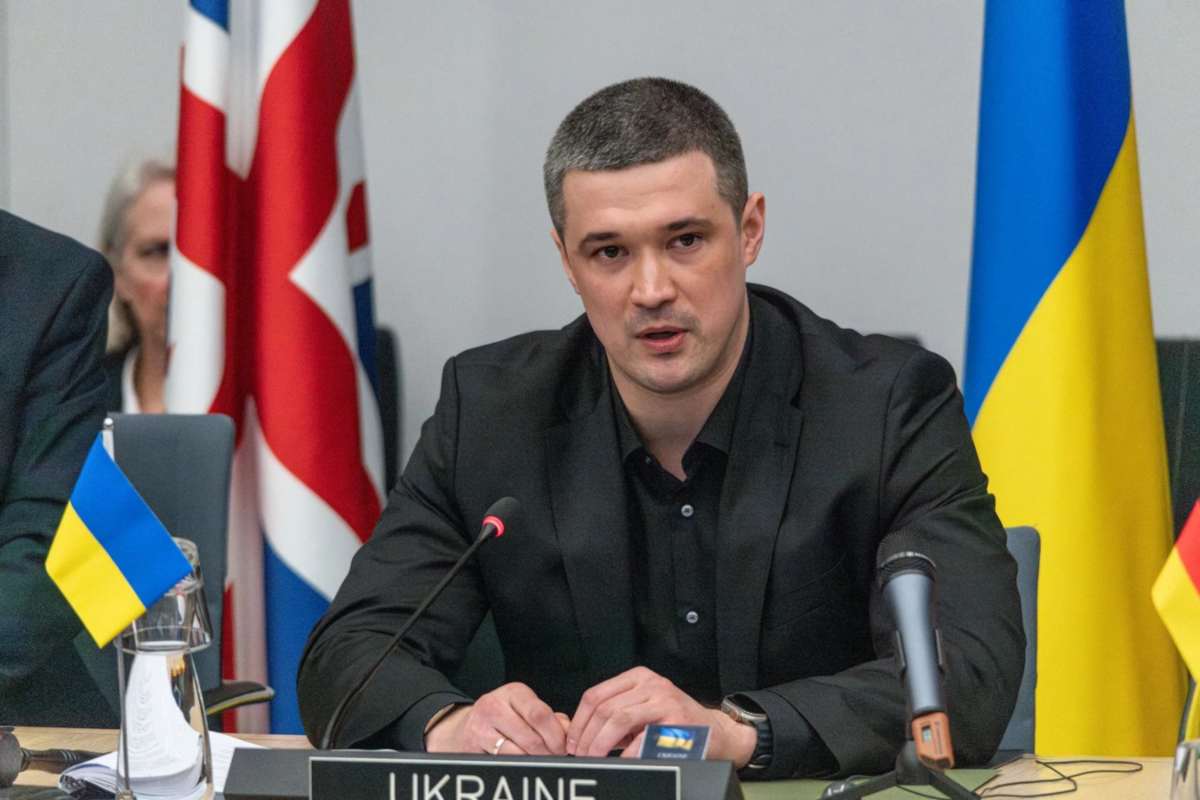
Mykhailo Fedorov, who became defence minister in early 2026, had pushed a more digitised procurement system designed to make inflated contracts, kickbacks and opaque purchasing practices harder to conceal.
He was removed in July following institutional tensions with the military leadership.
His departure immediately generated political controversy, with demonstrators using the slogan “corruption kills.”
That leaves Kyiv in an uncomfortable position.
Ukraine may understand the procurement problem better than it did two years ago.
But its capacity to demonstrate a fast and politically convincing response is now being tested again.
Can the Reform Team Survive the Minister?
Fedorov’s successor, Yevhenii Khmara, has asked members of the procurement reform team to remain at the ministry.
That matters because Western — particularly European — confidence increasingly depends not simply on Ukraine promising reform, but on demonstrating functioning institutions capable of enforcing it.
There is also an important distinction.
The audits concern procurement in 2024, before the newer reforms were introduced.
Kyiv can therefore argue that the report exposes failures in an earlier system.
But that argument will only work if the government can demonstrate that those failures are no longer being tolerated.
The Real Test: Who Gets Punished — and How Quickly?
This is now the decisive question.
Not another declaration of zero tolerance.
Not another promise of transparency.
Concrete action.
Contract cancellations.
Investigations.
Prosecutions where evidence supports them.
Public accountability.
And above all, scrutiny of the companies identified as continuing to receive government business despite earlier defaults or investigations.
If Kyiv acts rapidly, it can attempt to change the narrative from corruption to institutional self-correction.
If it hesitates, the scandal could become far more durable.
Washington Could Turn Corruption into a Condition
This is where the economic consequences could become much larger.
The downside scenario is not simply that US aid sceptics use the findings to attack Ukraine politically.
It is that corruption concerns become embedded in the architecture of future financial support.
Washington could push for measures such as:
- dedicated oversight mechanisms;
- escrow arrangements;
- audits before disbursement;
- tighter restrictions on the use of funds;
- anti-corruption benchmarks tied to reconstruction financing.
At that point, the scandal would stop being merely a news-cycle problem.
It would become part of the financial terms governing Ukraine’s post-war future.
Europe Is Watching Too
The same applies to the European Union.
Corruption is not simply an issue surrounding wartime assistance.
It is directly relevant to Ukraine’s EU accession ambitions.
Rule of law, institutional independence, transparent procurement and effective anti-corruption enforcement sit at the heart of the accession process.
A major defence procurement scandal therefore cannot be separated from the broader debate over European funding, reconstruction and Ukraine’s eventual integration into the EU.
Moscow Does Not Need to Prove Everything
Russia’s objective is different.
Moscow does not need to prove that the entire Ukrainian state is corrupt.
It needs to create doubt.
The political message is easy to understand:
Why should Western taxpayers send more money if billions can be lost through corruption and mismanagement?
Even if the answer is that the disputed amount represents only a fraction of overall assistance — or that Ukrainian institutions themselves uncovered the wrongdoing — the political effect can begin immediately.
The Paradox Behind the Investigation
There is another side to the story that should not be ignored.
The fact that Ukrainian government audits identified the alleged losses also demonstrates that mechanisms exist to detect wrongdoing.
That does not erase the corruption.
But there is an important distinction between a system that conceals misconduct and one that discovers it and subsequently acts against it.
The battle over Ukraine’s credibility will increasingly revolve around that distinction.
Discovery is not enough.
Enforcement is what matters next.
Witkoff, Kushner and Dangerous Timing
The coincidence with Washington’s diplomatic push makes the story even more sensitive.
Steve Witkoff has already faced criticism over perceptions of his approach toward Moscow, while scepticism surrounds how competing Russian and Ukrainian narratives are being handled during negotiations.
A fresh corruption scandal now gives ammunition to several groups simultaneously.
Moscow can use it to argue against favourable treatment for Kyiv.
American aid sceptics can use it to demand tighter controls.
And Ukraine must demonstrate that the findings are not evidence of systemic dysfunction that Western financing cannot overcome.
The Most Dangerous Scenario for Ukraine
The greatest risk is not that the story remains on newspaper front pages.
It is that it moves into the fine print of diplomacy.
If corruption concerns become the basis for tighter financial supervision, delayed disbursements, external control over reconstruction funds or new political conditions on assistance, the long-term cost could become far greater than the $1.2 billion identified in the audits.
A corruption story would then have changed the architecture of Ukraine’s post-war financing.
Corruption Has Its Own Geopolitical Clock
That is the central lesson.
Ukraine’s corruption problem does not move according to the rhythm of the battlefield.
It does not need to change a front line to alter the diplomatic balance.
A scandal can emerge while Congress is debating assistance.
It can land during peace negotiations.
And its political value can become vastly greater than its actual financial scale.
That is why Kyiv’s most important question is no longer whether $1.2 billion is large or small compared with the overall cost of the war.
It is how quickly Ukraine can demonstrate that it can investigate, punish and close the institutional loopholes that allowed the losses to occur.
Because at this stage of the war, credibility is itself a strategic asset.
Source: pagenews.gr
Διαβάστε όλες τις τελευταίες Ειδήσεις από την Ελλάδα και τον Κόσμο