Grant Thornton Sounds €3.7 Billion Gas Alarm: Greece Faces a Costly Winter as Europe’s Energy Risks Mount
 ΧΡΟΝΟΣ ΑΝΑΓΝΩΣΗΣ 17 '
Πηγή Φωτογραφίας: AP Photo//Grant Thornton Sounds €3.7 Billion Gas Alarm: Greece Faces a Costly Winter as Europe’s Energy Risks Mount



Greece is entering the winter of 2026–2027 facing a potentially severe energy cost shock, even as its strategic importance in Europe’s natural gas market continues to grow.
An analysis by Grant Thornton highlights a striking economic risk: if natural gas prices remain at the levels recorded on October 13, 2026, rather than returning to February levels, the additional annual cost associated with Greek domestic gas consumption could reach approximately €3.7 billion.
The figure is not a forecast of actual household bills, government expenditure or GDP losses. It is a hypothetical estimate illustrating the economy’s exposure to elevated wholesale gas prices under specific assumptions.
Nevertheless, the calculation underscores a fundamental vulnerability in Greece’s evolving energy model.
The country is rapidly becoming an important gateway for LNG supplies to Southeastern and Central Europe. At the same time, its domestic economy remains exposed to international gas prices, while its infrastructure must accommodate growing regional demand.
The central challenge is no longer simply whether Greece can transport more natural gas. It is whether the country can secure sufficient volumes at competitive prices when European demand peaks.
The €3.7 Billion Warning: How the Calculation Works
Grant Thornton’s analysis uses Greece’s domestic natural gas consumption during the first nine months of 2026 to estimate an annualized demand of approximately 66.5 terawatt-hours (TWh).
Under the simplifying assumption that all volumes are priced against the Dutch Title Transfer Facility (TTF) benchmark, every €10/MWh increase in the gas price translates into approximately €665 million in additional annual costs.
The TTF price stood at approximately €31/MWh in February 2026.
By October 13, it had reached €86/MWh.
That €55/MWh increase produces an indicative annual cost difference of approximately €3.7 billion.
The calculation assumes constant consumption, full exposure to TTF pricing and the persistence of elevated prices throughout the year.
Actual costs could differ considerably because of long-term contracts, hedging arrangements, alternative pricing mechanisms, seasonal demand patterns and changes in consumption.
However, the exercise illustrates how sharply Greece’s energy bill could respond to sustained international price increases.
For businesses operating with narrow margins, particularly energy-intensive manufacturers, such volatility can influence production decisions, investment planning and competitiveness.
For households, higher wholesale gas prices can also affect heating expenses and electricity costs.
From €31 to €86: The Gas Price Shock
The European natural gas market has experienced a dramatic repricing during 2026.
According to the analysis, the disruption began following the closure of the Strait of Hormuz on February 28, affecting LNG supplies from the Gulf.
The interruption removed access to more than 280 million cubic meters of gas per day, equivalent to approximately one-fifth of global LNG supply.
A substantial share of the disruption was associated with Qatar’s Ras Laffan LNG complex.
Although Qatar accounted for approximately 8% of the European Union’s LNG imports in 2025, the consequences extended far beyond Europe’s direct dependence on Qatari cargoes.
Asian buyers also needed replacement supplies.
As a result, European and Asian importers increasingly competed for flexible LNG cargoes, particularly those originating in the United States.
This competition pushed prices higher.
The TTF benchmark averaged €76.48/MWh in September before reaching €86/MWh on October 13, its highest level since December 2022, according to the figures cited by Grant Thornton.
Forward markets were already pricing in a difficult winter.
On September 30, the winter 2026–2027 contract stood at €72.35/MWh, compared with €53.41/MWh for summer 2027.
The nearly €19/MWh premium reflected the higher value assigned to securing gas during the approaching winter months.
However, lower forward prices for summer 2027 represent market expectations rather than a guarantee that supply conditions will normalize.
Europe Enters Winter With a 130 TWh Storage Deficit
One of the most concerning elements of Grant Thornton’s analysis is the condition of European natural gas storage facilities.
On October 1, 2026, European storage was approximately 72% full.
A year earlier, the corresponding level had been 83%.
In energy terms, inventories amounted to approximately 811 TWh, compared with 940 TWh in October 2025.
The resulting deficit of roughly 130 TWh significantly reduces Europe’s ability to absorb another major supply disruption.
The contrast with 2022 is also revealing.
Despite exceptionally high prices during that year’s energy crisis, Europe managed to fill its storage facilities to approximately 95% by November 1, accumulating around 1,060 TWh.
Although the comparison involves dates one month apart, it illustrates the scale of Europe’s current replenishment challenge.
Storage facilities are not merely commercial assets.
They provide flexibility during periods of unusually high demand, infrastructure interruptions and unexpected supply shortages.
Lower inventories mean that European buyers may need to purchase additional LNG precisely when global competition is most intense.
ENTSOG Scenarios: Demand Cuts of Up to 12% Under Severe Conditions
The European Network of Transmission System Operators for Gas, ENTSOG, has modeled several potential outcomes for winter 2026–2027.
Under a reference winter with adequate LNG supplies, European storage could finish the heating season at approximately 29% capacity on March 31, 2027.
If LNG availability is constrained, that figure falls to 13%.
The outlook becomes more challenging under unusually cold weather conditions.
Even with sufficient LNG supplies, a cold winter could require a 7% reduction in modeled gas demand.
If severe cold coincides with limited LNG availability, the required demand adjustment rises to 12%.
Under both cold-winter scenarios, storage levels fall to approximately 11%.
The modeled adjustment corresponds to between 237 and 437 TWh, depending on the scenario.
These figures do not mean that mandatory rationing or widespread supply interruptions are inevitable.
They describe potential system requirements under adverse assumptions.
Demand adjustments could involve energy savings, fuel switching, industrial demand reductions or other measures designed to maintain system balance.
Nevertheless, the scenarios demonstrate that Europe’s energy security remains highly sensitive to weather conditions and global LNG availability.
Southeastern Europe Faces Greater Infrastructure Constraints
The risks are particularly significant for Southeastern Europe.
Grant Thornton highlights an adverse ENTSOG peak-demand scenario involving relatively low storage inventories and the absence of Russian pipeline gas.
Under those assumptions, unmet gas demand could reach 12% in Southeastern Europe, compared with 6% across the European Union.
The problem is not simply the availability of natural gas somewhere in Europe.
It is also the ability to move that gas efficiently to the markets where it is needed.
Pipeline bottlenecks and limited cross-border transportation capacity restrict the movement of supplies from Western European LNG terminals toward Southeastern European consumers.
This is precisely where Greece’s energy infrastructure becomes strategically important.
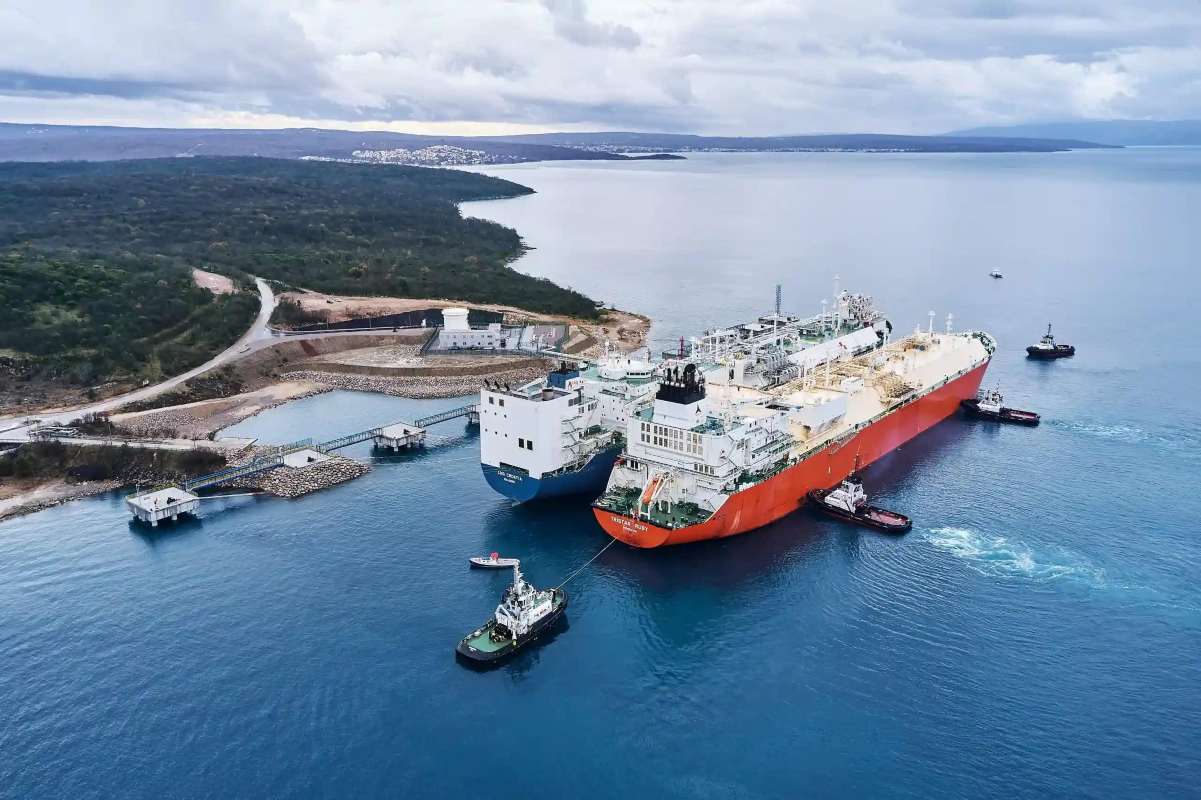
Its LNG terminals and northbound interconnections offer additional entry points for gas destined for Balkan and Eastern European markets.
The more constrained Europe’s internal transportation system becomes, the greater the strategic value of reliable alternative supply corridors.
Greece’s Gas Exports Surge 169%
The most significant structural development in Greece’s natural gas market is the rapid expansion of exports.
During the first nine months of 2026, total gas volumes exiting the Greek transmission system increased by approximately 13%, from 56.4 TWh to 63.5 TWh.
However, the increase was not driven by domestic consumption.
Greek domestic gas demand declined from approximately 51.3 TWh to 49.9 TWh.
Exports, meanwhile, rose from around 5.1 TWh to 13.6 TWh.
That represents an increase of approximately 169%.
The additional 8.5 TWh of exports more than offset the decline in domestic demand.
As a result, approximately 21% of the gas volumes exiting the Greek system were directed toward foreign markets.
This represents an important transformation.
Greece is increasingly functioning not only as a domestic gas market but also as a regional transportation and supply platform.
The development strengthens the country’s geopolitical relevance and creates commercial opportunities for infrastructure operators, gas traders and energy companies.
However, export growth also increases the importance of reliable procurement, financing and transmission capacity.
The Vertical Gas Corridor: Greece’s Strategic Opportunity
The rapid growth in Greek gas exports reinforces the importance of the Vertical Gas Corridor, which seeks to facilitate northbound gas transportation through interconnected European transmission systems.
The initiative is designed to improve access to supplies for Bulgaria, Romania and other regional markets.
Its strategic relevance becomes particularly clear when European storage is low and traditional transportation routes face constraints.
Greece’s LNG infrastructure can provide an alternative gateway for supplies entering Southeastern Europe.
Yet infrastructure alone does not guarantee commercial success.
The corridor requires long-term supply contracts, reliable customers, sufficient booked capacity and transportation tariffs that allow gas to reach its final destination at competitive prices.
These conditions are essential for transforming geographical advantages into sustainable economic returns.
The development of the corridor also creates a more demanding operating environment.
During a severe cold spell, Greek domestic consumption could rise at the same time as demand increases in neighboring countries.
The same LNG terminals and transportation systems would then face simultaneous pressure from domestic and export markets.
Managing this risk requires advance planning, contractual flexibility and regional coordination.
LNG Now Accounts for Almost Half of Greek Gas Imports
Another major finding concerns the changing composition of Greece’s gas supplies.
During the first nine months of 2026, pipeline imports remained broadly stable at approximately 33.4 TWh.
LNG imports, by contrast, increased by 32% to approximately 30.2 TWh.
As a result, LNG accounted for around 47.5% of total gas imports.
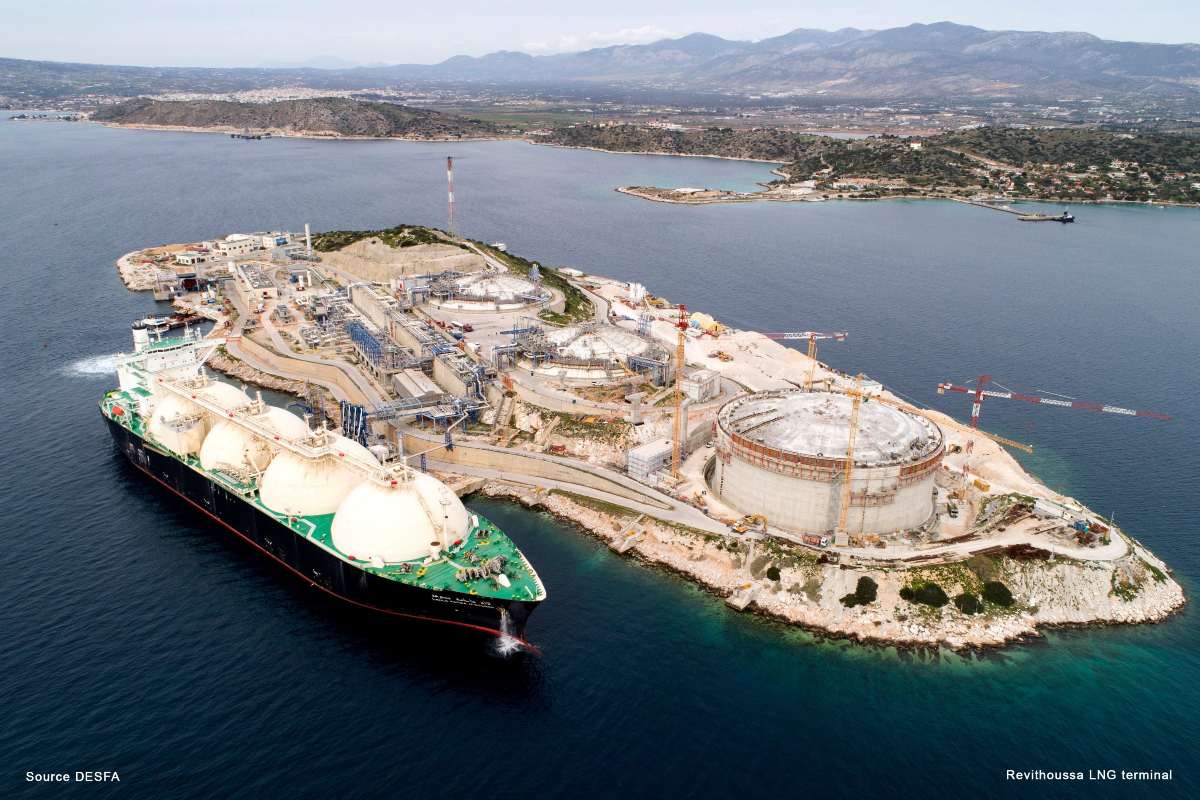
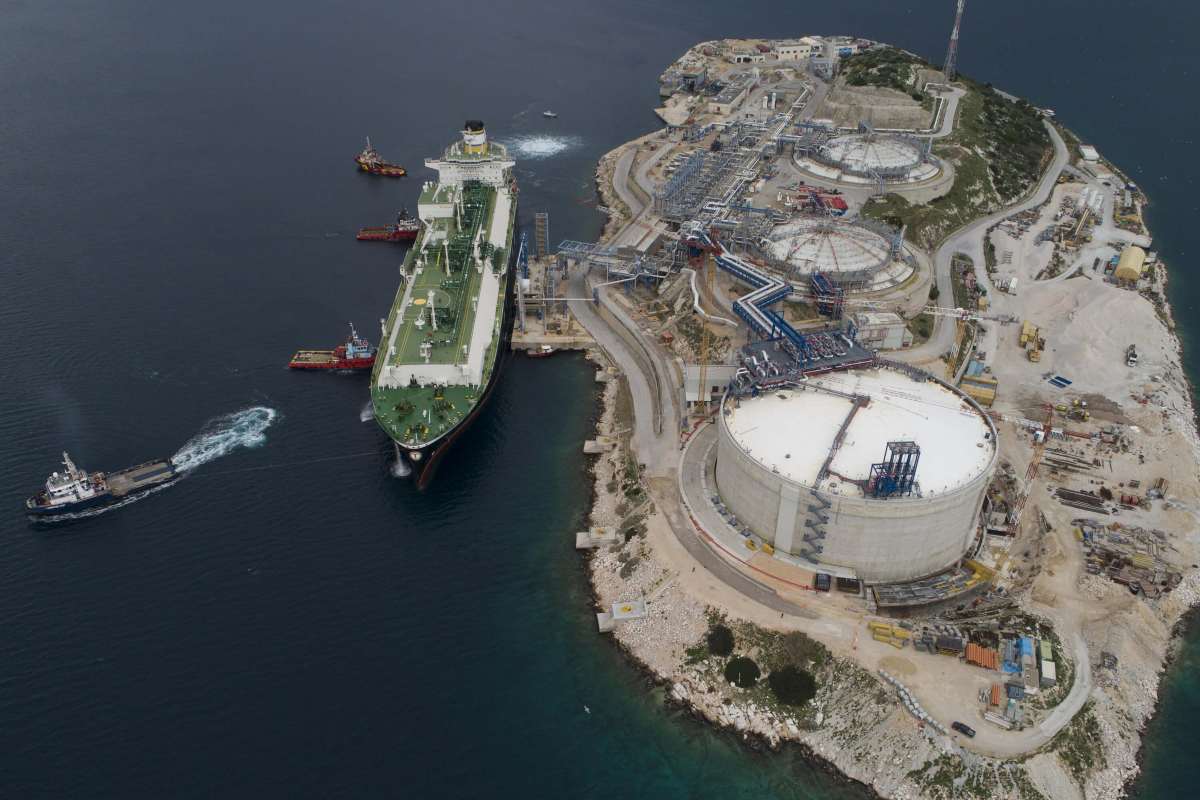
The Revithoussa terminal handled approximately 24.3 TWh.
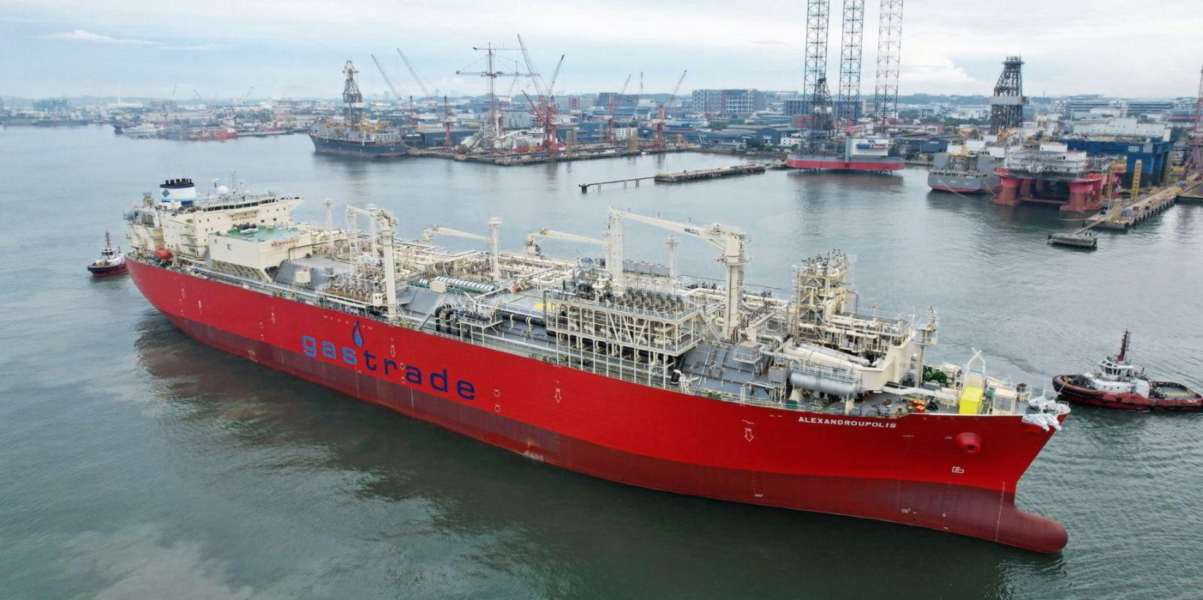
The Alexandroupolis floating storage and regasification unit contributed another 5.8 TWh.
Alexandroupolis recorded a particularly significant increase compared with the previous nine-month period, strengthening the Greek system’s ability to accommodate additional LNG volumes.
The development provides greater supply diversification and supports Greece’s role as a regional energy hub.
However, a larger LNG share also means greater exposure to global cargo availability, shipping conditions and international price competition.
American LNG Dominates Supplies to Revithoussa
The United States has become the dominant supplier of LNG unloaded at Greece’s Revithoussa terminal.
According to the figures presented in the analysis, American cargoes accounted for approximately 17.88 TWh during the first nine months of 2026.
That represents 73.7% of LNG deliveries to Revithoussa.
Nigeria ranked second, supplying approximately 4.16 TWh, equivalent to 17.2%.
Smaller quantities originated from Congo, Egypt, Algeria and Mauritania.
These percentages refer specifically to Revithoussa, not to all LNG entering Greece.
The figures nevertheless demonstrate the growing importance of American gas in the country’s energy supply structure.
This creates a clear geopolitical dimension.
Greece is increasingly integrated into the US-European LNG trade, strengthening commercial and strategic energy ties with Washington.
At the same time, a high concentration of supplies from one country raises questions about procurement diversification and exposure to common market risks.
Even when cargoes originate outside the Middle East, their prices remain influenced by global LNG market conditions.
AKTOR, DEPA and the Commercial Future of the Corridor
The developments highlighted by Grant Thornton also provide important context for the commercial strategy of Atlantic SEE LNG Trade, the joint venture between the AKTOR Group and DEPA Commercial.
The company has pursued long-term American LNG supply agreements intended to support deliveries into Southeastern and Eastern European markets.
Its agreement with Venture Global provides a foundation for future supplies, while commercial arrangements with regional counterparties are intended to develop a broader customer base.
The success of this strategy depends on converting supply commitments into reliable long-term sales and ensuring access to competitively priced transportation capacity.
This is especially important in a market characterized by elevated prices and increasing competition for LNG cargoes.
For Greece, the strategic objective is not merely to receive additional American gas.
It is to establish a commercially sustainable supply chain connecting American producers with European consumers through Greek infrastructure.
The Vertical Gas Corridor’s long-term value will depend on its ability to deliver gas reliably and competitively, not simply on the amount of infrastructure available.
Electricity Prices: How the Gas Shock Reaches the Wider Economy
Natural gas remains closely connected to Greece’s electricity market.
According to the analysis, gas-fired power generation accounts for approximately two-thirds of domestic gas consumption.
This creates an important transmission channel between international gas prices and electricity production costs.
When natural gas becomes more expensive, the variable operating costs of gas-fired power stations increase.
During periods when these plants set the wholesale electricity price, higher fuel costs can influence the broader power market.
The extent to which wholesale increases reach households and businesses depends on supply contracts, hedging arrangements, electricity generation patterns and market conditions.
Nevertheless, sustained high gas prices can affect the competitiveness of energy-intensive industries and place additional pressure on household budgets.
The challenge is therefore broader than the natural gas market itself.
It concerns the cost structure of the Greek economy.
The Storage Problem and the Transition Away From Russian Gas
Greece does not currently have an operational underground natural gas storage facility capable of providing substantial seasonal reserves.
This increases the importance of LNG scheduling, pipeline reliability and advance supply commitments.
The challenge is compounded by Europe’s transition away from Russian gas.
According to the figures cited in the analysis, gas flows through Sidirokastro reached approximately 25.4 TWh during the first nine months of 2026, representing around 40% of Greek imports.
Grant Thornton identifies the replacement of Russian-origin supplies as a significant challenge in the period leading up to November 2027.
Replacing these volumes would require additional LNG procurement, alternative pipeline supplies, transportation capacity and commercial arrangements.
Greater utilization of the Trans Adriatic Pipeline could contribute, provided sufficient gas volumes and transmission capacity are available.
The transition also increases the importance of regional coordination and the timely development of replacement supply arrangements.
Four Priorities for Greece’s Energy Security
The findings point to four strategic priorities for the Greek energy system.
First, longer-term LNG contracts could reduce exposure to sudden price increases and improve procurement predictability.
Second, supplier diversification and more systematic price hedging could strengthen resilience against global market disruptions.
Third, regional stress tests and closer coordination among transmission operators could improve preparedness for simultaneous demand peaks across Southeastern Europe.
Fourth, greater flexibility in electricity generation and consumption—including energy storage, power purchase agreements and demand-response mechanisms—could help reduce exposure to gas price volatility.
These measures cannot eliminate international energy risks.
They can, however, improve the ability of the Greek economy and energy system to withstand adverse market conditions.
The Bigger Picture: Greece’s Energy Ambitions Face a Critical Test
Grant Thornton’s analysis reveals a fundamental shift in Greece’s position within Europe’s energy landscape.
The country has developed substantial LNG infrastructure, increased its regional exports and strengthened its role in supplying neighboring markets.
These achievements enhance Greece’s geopolitical importance and create opportunities for long-term commercial growth.
Yet the expansion of its regional role brings new responsibilities and vulnerabilities.
Higher gas prices can impose significant costs on the domestic economy.
Lower European storage inventories increase the importance of reliable supply arrangements.
And stronger demand from neighboring countries places greater pressure on Greece’s infrastructure during periods of market stress.
The potential €3.7 billion annual cost increase is therefore best understood as a warning about economic exposure rather than a predetermined financial outcome.
Greece’s energy future will be determined not only by how much gas it can transport, but by how reliably it can secure that gas, how competitively it can deliver it and how effectively it can protect domestic consumers from international price shocks.
The winter of 2026–2027 will be an important test of Europe’s gas market resilience and Greece’s emerging role as a strategic energy gateway.
For Athens, the objective is clear: turn growing geopolitical importance into sustainable economic value without allowing greater international exposure to become a new source of domestic vulnerability.
Sources: Grant Thornton, Greece’s Gas Market at an Inflection Point: Regional Export Hub in a Tight European Winter; ENTSOG Winter Supply Outlook 2026/27; Gas Infrastructure Europe; DESFA natural gas market data.
Διαβάστε όλες τις τελευταίες Ειδήσεις από την Ελλάδα και τον Κόσμο