Turkish NAVTEX Sparks New Tensions: Greece Rejects Ankara’s Claims as French Vessel Faces Critical Test
 ΧΡΟΝΟΣ ΑΝΑΓΝΩΣΗΣ 13 '
Πηγή Φωτογραφίας: AP Photo/Turkish NAVTEX Sparks New Tensions: Greece Rejects Ankara’s Claims as French Vessel Faces Critical Test



A new diplomatic confrontation is unfolding in the Eastern Mediterranean after Turkey issued a NAVTEX concerning maritime activities linked to the Greece–Cyprus electricity interconnection project, prompting a Greek response and renewed debate over maritime jurisdiction, sovereign rights and the role of France.
Greek Deputy Foreign Minister Giannis Loverdos firmly rejected Ankara’s claims during a televised discussion, arguing that the Turkish maritime notice has no legal foundation and does not alter Greece’s position regarding its sovereign rights.
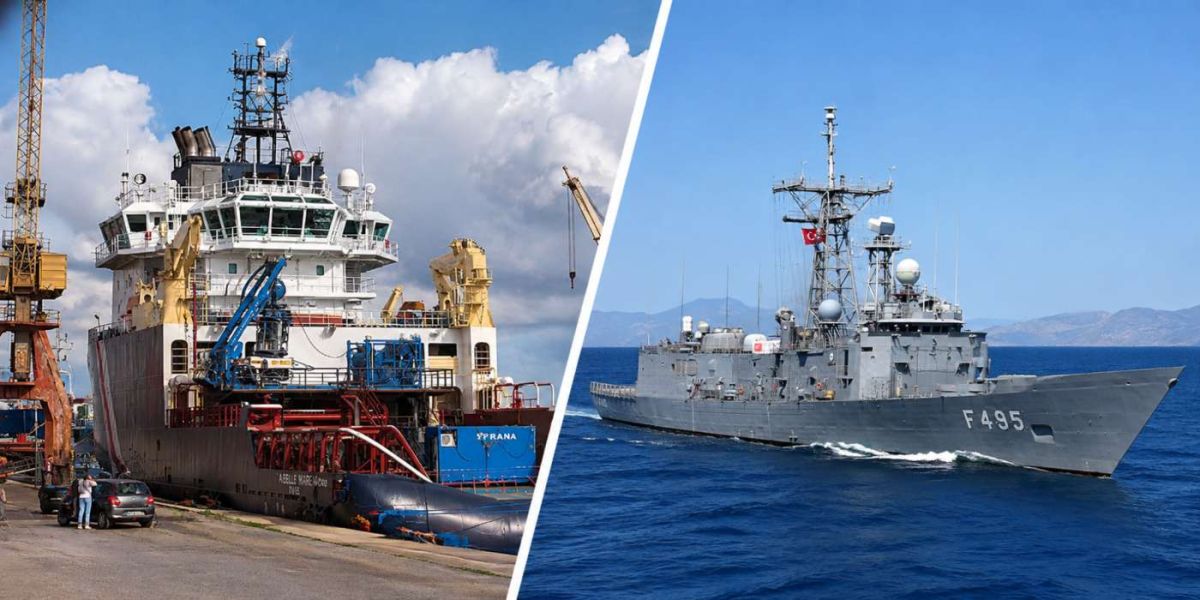
At the center of the dispute is a French research vessel operating in connection with the planned electricity link between Greece and Cyprus, a strategically important project intended to strengthen Cyprus’s integration into the European electricity network.
The controversy has also triggered domestic political tensions in Athens, with opposition parties demanding explanations about a French diplomatic note sent to Turkey and questioning whether the communication could create an undesirable precedent.
Loverdos: “The Turkish NAVTEX is invalid, illegal and unfounded”
Loverdos dismissed the Turkish NAVTEX as legally meaningless, suggesting that Ankara’s decision was driven primarily by domestic political considerations.
“The Turkish NAVTEX is not only invalid, illegal and unfounded. In my opinion, it is also irrational,” he said.
The deputy foreign minister argued that Turkey may have issued the notice to demonstrate to its domestic audience that it had not abandoned its maritime claims.
“The only logical explanation I can offer — and this is an assessment, because I have no evidence — is that it was issued to exploit the issue for domestic public opinion,” he stated.
His remarks reflected Athens’ position that Turkey cannot establish maritime jurisdiction through unilateral announcements in areas where Greece asserts sovereign rights.
However, the Turkish government maintains competing maritime claims in parts of the Eastern Mediterranean, making the dispute part of a broader and longstanding disagreement over continental shelf and exclusive economic zone boundaries.
The French diplomatic note: Notification or request for permission?
The central controversy concerns a French diplomatic communication addressed to Turkey before the Turkish NAVTEX was issued.
Greek opposition figures have questioned whether the wording of the French note could be interpreted as seeking Turkish consent for the vessel’s operations.
Loverdos rejected that interpretation.
“Nobody was asked for permission. Naturally, only Greece and Cyprus could issue the relevant authorizations, and they did. No consent, no approval, nothing else was requested,” he said.
According to the deputy foreign minister, the French communication was a notification rather than a request for authorization.
The distinction is particularly important because it concerns three separate issues:
- Greek and Cypriot authorizations: Athens maintains that the vessel’s research activities were covered by the relevant permissions issued by Greece and Cyprus.
- French diplomatic notification: The Greek government describes the communication as an informational measure directed toward coastal states.
- Turkish NAVTEX: Ankara used its maritime notice to reiterate its own jurisdictional claims in the disputed area.
The precise wording of the French note remains central to assessing the diplomatic implications of the episode.
Athens and the opposition clash over a possible diplomatic precedent
The dispute has also intensified political tensions in Greece.
Opposition parties, including PASOK, have demanded further clarification about the French communication and the circumstances surrounding Turkey’s NAVTEX.
Their concern is that repeated notifications to Ankara, even without formal requests for permission, could eventually be used by Turkey to support its claims of jurisdiction.
Loverdos accused the opposition of exploiting sensitive foreign policy matters for domestic political purposes.
“The opposition demands many things without knowing the facts, and above all it instrumentalizes them for domestic reasons,” he argued.
He continued:
“In matters of foreign policy and defense, this kind of instrumentalization for domestic political purposes should not take place.”
The deputy foreign minister challenged critics to identify any specific sovereign right Greece had surrendered.
“At what point have we conceded any sovereign right? They do not say,” he stated.
For the government, the decisive issue is whether Greece continues to exercise its rights and whether the electricity interconnection project proceeds.
For its critics, the question is whether diplomatic handling today could influence the way third countries approach Turkish claims in future maritime operations.
Turkish media portray the NAVTEX as a diplomatic success
Reporting from Istanbul during the televised discussion highlighted differing reactions within Turkey.
According to the correspondent, some Turkish outlets portrayed Ankara’s NAVTEX as evidence that the French vessel was operating with Turkish consent.
Others went further, suggesting that Turkey had effectively authorized the research activities.
However, the correspondent also noted that the issue had not dominated the broader Turkish media landscape, with more emphatic coverage concentrated in nationalist circles.
The discussion referred to retired Turkish naval officer Yankı Bağcıoğlu, who reportedly questioned whether France had sought authorization from Ankara alone or had also communicated with Athens.
The intervention raised a politically sensitive question within Turkey itself: if the French vessel did not request Turkish authorization, what was the procedural basis for issuing the Turkish notice?
That question supports the Greek government’s interpretation that the NAVTEX was primarily intended to reinforce Ankara’s political messaging.
It does not, however, resolve the underlying maritime jurisdiction dispute.
Cem Gürdeniz and the prospect of Turkish naval surveillance
Another important element concerned retired Turkish admiral Cem Gürdeniz, a prominent advocate of the Blue Homeland maritime doctrine.
According to the Istanbul correspondent, Gürdeniz called for clarification about who requested the Turkish NAVTEX, when the request was made and under what procedure consent was supposedly granted.
He also reportedly suggested that Turkish naval vessels should monitor the French research ship from a distance if it enters waters Ankara considers to fall within Turkish jurisdiction.
These remarks do not constitute an official Turkish military announcement.
Nevertheless, they illustrate the potential for a diplomatic disagreement to acquire an operational military dimension.
The possibility of Turkish naval surveillance has revived concerns about a repetition of earlier tensions around Kasos, where competing maritime claims have complicated research activities.
General Kambas: The French vessel departed before Turkey issued its NAVTEX
Retired Greek Army General Giorgos Kambas, who participated in the discussion, focused on the sequence of events.
He noted that the French research vessel had departed from Heraklion before Turkey issued its NAVTEX.
In his assessment, the timing was significant because it prevented Ankara from portraying its own maritime notice as a prerequisite for the vessel’s departure.
Kambas argued that the ship had begun operating under the Greek and Cypriot framework before Turkey attempted to assert jurisdiction through its announcement.
However, he also identified a potential long-term diplomatic risk.
Even when a third country merely informs Turkey about planned operations, Ankara could attempt to use repeated notifications as evidence of an established practice.
That possibility, he warned, could become relevant to future research activities south of Crete, particularly in areas affected by Turkey’s maritime agreement with Libya.
The Libya connection: Could the dispute affect future energy exploration?
The debate extends beyond the Greece–Cyprus electricity cable.
The Turkey–Libya maritime memorandum remains a major source of friction because its claimed boundaries overlap areas where Greece asserts maritime rights.
Kambas warned that the diplomatic handling of the current research activities could influence future operations involving international energy companies.
The concern is that Turkey might increasingly insist on receiving notifications or claiming a role in authorizing research conducted by foreign companies in areas it considers part of its maritime jurisdiction.
Such a practice would not automatically establish legal rights.
However, it could complicate operations and create additional diplomatic pressure on Greece and its international partners.
The issue is particularly relevant to prospective hydrocarbon exploration south of Crete, where major energy interests intersect with unresolved regional maritime disputes.

The critical test near Kasos: Will the research vessel proceed unhindered?
The most immediate question concerns what happens when the French vessel continues its operations in areas claimed by Ankara.
During the discussion, Kambas suggested that Turkish naval vessels or unmanned systems could monitor the research ship.
He considered it possible that Turkish units might communicate their jurisdictional claims to the vessel without necessarily attempting to physically prevent its passage.
These were military assessments rather than confirmed reports of planned Turkish deployments.
Loverdos expressed confidence that the vessel would proceed, while maintaining that Greece was capable of protecting its sovereignty and sovereign rights if necessary.
The distinction between monitoring and obstruction is crucial.
A Turkish naval presence would not necessarily prevent research activities, but an attempt to interfere with the vessel’s operations could produce a more serious diplomatic or military confrontation.
The outcome will therefore depend not only on the competing NAVTEX announcements but also on the conduct of the parties at sea.
Mitsotakis–Macron: Questions over an alleged diplomatic disagreement
The televised debate also addressed a report published by the Greek newspaper Estia concerning an alleged telephone conversation between Greek Prime Minister Kyriakos Mitsotakis and French President Emmanuel Macron.
The report suggested that disagreements had emerged over the handling of the French diplomatic communication.
Loverdos said he had no personal knowledge of the alleged exchange and questioned the basis on which its contents had been reported.
He did not provide independent confirmation or a definitive denial of the reported conversation.
As a result, claims of a diplomatic incident between Athens and Paris remain unverified on the basis of the interview.
The broader issue, however, is politically significant.
France is a key defense and strategic partner of Greece, and the involvement of a French research vessel gives the maritime dispute an additional European dimension.
Why did Egypt not issue a NAVTEX?
Another question raised during the discussion concerned Egypt, which was also reportedly notified about the planned activities.
Loverdos argued that Cairo had no reason to issue a comparable maritime notice because the vessel’s relevant route did not require an Egyptian announcement.
“Egypt had no reason to issue a NAVTEX, just as Turkey had no reason to issue one, except for propaganda purposes,” he said.
His position reinforced the Greek government’s argument that the French notification did not amount to recognition of Turkish authority.
The legal significance of any maritime notice depends on the relevant geographic coordinates, the nature of the activity and the applicable jurisdictional arrangements.
Greece’s right to extend its territorial waters remains on the table
The discussion also touched on Greece’s longstanding right under international law to extend its territorial sea to a maximum of 12 nautical miles.
Loverdos reiterated that Greece retains that right and may exercise it when it considers the circumstances appropriate and consistent with its national interests.
The issue is particularly sensitive in the Aegean, where Turkey has historically opposed such an extension.
The distinction between territorial sovereignty and sovereign rights over the continental shelf or exclusive economic zone remains essential to understanding the dispute.
The current controversy concerns research activities and competing jurisdictional claims, rather than a formal change to the breadth of Greek territorial waters.
The broader geopolitical stakes: Energy security and maritime power
The Greece–Cyprus electricity interconnection is more than an infrastructure project.
It is intended to reduce Cyprus’s energy isolation, strengthen regional electricity connectivity and contribute to the European Union’s energy security objectives.
Its strategic significance also makes it vulnerable to broader geopolitical competition.
For Greece, the successful continuation of the research activities would demonstrate that unilateral Turkish objections cannot automatically halt projects supported by Athens, Nicosia and their international partners.
For Turkey, maintaining its maritime claims remains part of a wider effort to influence the regional balance of power.
For France and the European Union, the dispute raises questions about how European-backed infrastructure projects can advance in maritime areas affected by competing jurisdictional claims.
The coming developments around Kasos will therefore be closely watched.
The central test is not simply who issued a NAVTEX, but whether the French research vessel can complete its mission without obstruction — and whether the Greece–Cyprus electricity interconnection can move forward despite the geopolitical pressure surrounding it.
Source: pagenews.gr
Διαβάστε όλες τις τελευταίες Ειδήσεις από την Ελλάδα και τον Κόσμο