Early Elections or Strategic Patience? The Mitsotakis Dilemma Now Being Discussed in Brussels
 ΧΡΟΝΟΣ ΑΝΑΓΝΩΣΗΣ 5 '
Πηγή Φωτογραφίας: eurokinissi//Early Elections or Strategic Patience? The Mitsotakis Dilemma Now Being Discussed in Brussels



Athens officially denies any plans for snap elections. But once speculation over Greece’s electoral timetable reaches the pages of POLITICO, it ceases to be merely a domestic political debate.
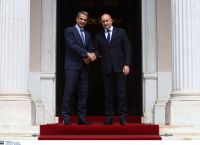
A new POLITICO report has brought into focus a question increasingly discussed in political and diplomatic circles across Brussels: will Prime Minister Kyriakos Mitsotakis stick to his commitment to complete his term through 2027, or could he seize the political initiative and call an early election this autumn?
Publicly, the Greek government remains firm. Mitsotakis has repeatedly stated that parliamentary elections will take place in the spring of 2027.
Behind the scenes, however, POLITICO reports that senior figures within New Democracy are weighing whether the political landscape may become significantly more challenging if the government waits another year.
The New Democracy Paradox
Despite sustained pressure from inflation, the OPEKEPE subsidy scandal, and ongoing criticism over the government’s handling of the Tempi railway disaster, New Democracy remains comfortably ahead in national polling.
According to surveys cited by POLITICO, the governing party is polling near 30 percent—roughly double the support of its nearest rival.
Yet the concern within government circles is not primarily about today’s numbers.
It is about what Greece’s political map could look like twelve months from now.
Political erosion tends to be cumulative. As elections draw closer, pressure on opposition parties to coordinate, consolidate, and present a unified alternative tends to increase.
For New Democracy strategists, time may not necessarily be an ally.
The Tsipras Factor Changes the Equation
The emergence of Alexis Tsipras’ newly established political movement has altered calculations across the political spectrum.
According to the POLITICO report, the new ELAS party is already polling at approximately 16 percent, placing it in second position nationally.
Regardless of whether those numbers ultimately hold, many within New Democracy believe that the opposition landscape remains fluid and could evolve considerably over the coming months.
This explains why, according to sources cited by the publication, several senior government officials have reportedly advised Mitsotakis to consider elections sooner rather than later—before opposition forces gain sufficient time to reorganize and build momentum.
Why August Matters
Particular attention has been drawn to claims that Mitsotakis has instructed ministries to complete key policy and legislative priorities by the end of August.
Political observers interpret this less as evidence of an imminent election and more as an effort to preserve maximum strategic flexibility.
It does not prove that snap elections are planned.
But it suggests that the Prime Minister’s office wants all options available in what remains a highly fluid political environment.
The European Dimension Often Overlooked
In Brussels, discussions extend beyond polling numbers.
European officials are also focused on institutional timelines.
Greece is scheduled to assume the rotating Presidency of the Council of the European Union in 2027, a role that requires political stability and a fully functioning government.
Many European policymakers believe prolonged electoral uncertainty—or multiple election rounds resulting from coalition deadlock—could complicate preparations for that presidency.
For that reason alone, some analysts believe Athens may be quietly assessing alternative electoral scenarios.
The Thessaloniki International Fair as a Potential Turning Point
If an early election were ultimately chosen, most observers agree that the Thessaloniki International Fair (TIF) would likely become the launch platform.
Traditionally, the annual appearance of the Greek Prime Minister at the TIF serves as the government’s most important political and economic showcase.
It offers an opportunity to unveil new economic measures, present a governing record, and set out a forward-looking national agenda.
Against that backdrop, recent government adjustments and policy initiatives aimed at strengthening support among conservative voters have been interpreted by some analysts as signs of broader political positioning ahead of a potentially demanding electoral cycle.
No Final Decision Has Been Made
Despite growing speculation, there is currently no evidence that Kyriakos Mitsotakis has decided to alter the official electoral timetable.
Government officials continue to insist that elections will take place as scheduled in 2027.
Nevertheless, the significance of POLITICO’s report lies not in confirming an early election but in demonstrating that the option is now being discussed seriously within political and strategic circles.
In times of political uncertainty, economic pressure, and geopolitical volatility, the ability to choose the timing of an election remains one of the most powerful tools available to any incumbent leader.
The question is no longer whether the discussion exists.
The question is whether, by the end of the summer, it evolves from a strategic possibility into an operational political plan.
Source: pagenews.gr
Διαβάστε όλες τις τελευταίες Ειδήσεις από την Ελλάδα και τον Κόσμο