Pierrakakis’ Bold Brussels Plan: Turning Europe’s Airwaves Into Billions for the EU Budget
 ΧΡΟΝΟΣ ΑΝΑΓΝΩΣΗΣ 9 '
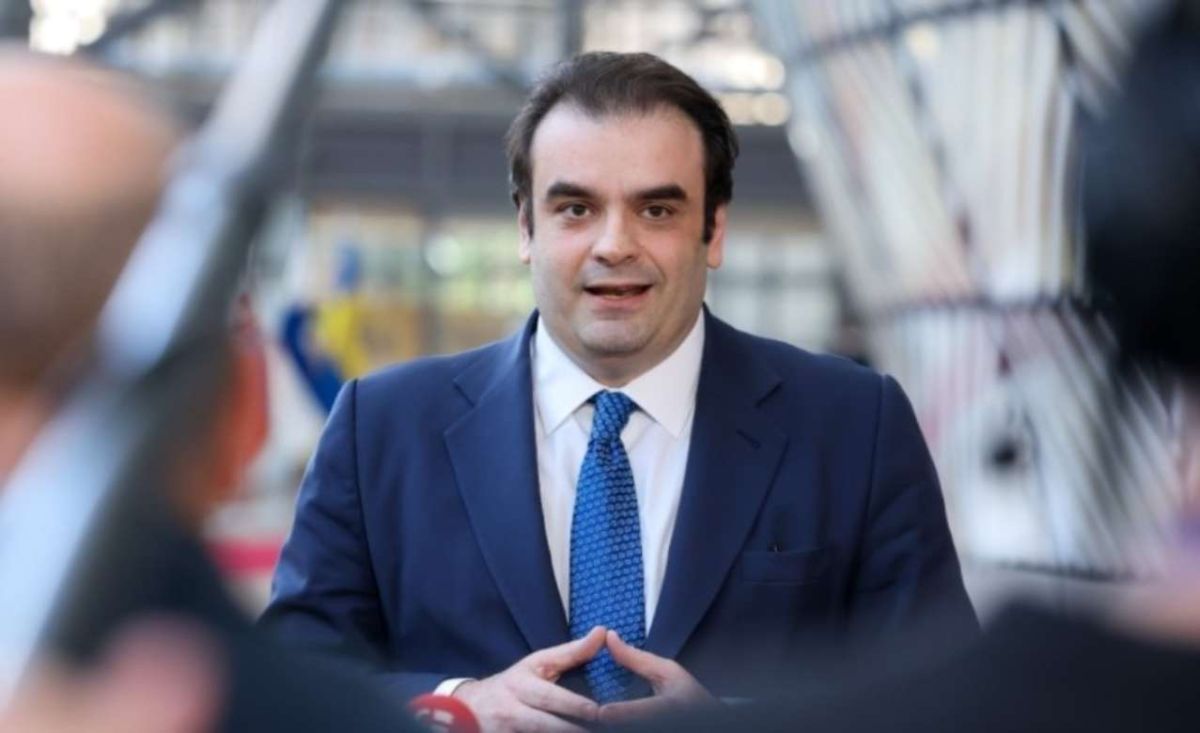
Πηγή Φωτογραφίας: eurokinissi//Pierrakakis’ Bold Brussels Plan: Turning Europe’s Airwaves Into Billions for the EU Budget



The Greek proposal gaining attention in Brussels
As the European Union searches for new sources of revenue ahead of negotiations on its 2028–2034 budget, Greek Finance Minister Kyriakos Pierrakakis is proposing a radically different approach.
According to Politico, Pierrakakis wants Europe to make better use of the revenues generated by national auctions of mobile radio spectrum — a valuable public asset that is currently managed and monetised separately by each member state.
The proposal would effectively create a new EU-level source of income, known in Brussels as an “own resource”, and reduce the bloc’s dependence on direct national contributions.
The formula: 75% for the EU budget, 25% for innovation
Pierrakakis’ plan is based on a two-part allocation model.
Seventy-five percent of the revenues generated by spectrum auctions would be directed to the EU’s Multiannual Financial Framework, helping finance common European priorities.
The remaining 25% would be channelled through a fund linked to the European Investment Bank, with the aim of supporting 5G networks, telecommunications infrastructure and emerging digital technologies.
The core logic is that spectrum revenues should not simply disappear into national budgets. They should also be used to generate future growth, investment and technological capacity.
As Pierrakakis argues, this could leave Europe with a much larger pool of capital overall.
From the Greek model to a European framework
The proposal is not purely theoretical.
It draws on the model adopted by Greece in 2020, when part of the proceeds from spectrum auctions was allocated to a venture capital fund supporting the country’s emerging 5G ecosystem.
That initiative was presented as a way to turn a one-off public revenue stream into a long-term investment tool.
Pierrakakis is now seeking to scale that idea up across the European Union.
His message is clear: the bloc should treat spectrum not merely as a source of cash, but as a strategic asset capable of financing digital development and European industrial policy.
A push for a single telecoms market
The proposal also addresses one of Europe’s long-standing structural weaknesses: the fragmentation of its telecommunications market.
At present, operators face different rules, schedules and auction systems in each member state.
This patchwork raises costs, complicates investment and makes it harder for large European telecoms companies to operate across borders at scale.
Pierrakakis argues that even a first step toward synchronising spectrum auctions would be a significant achievement.
A more coordinated approach could:
- reduce fragmentation,
- lower regulatory complexity,
- encourage cross-border investment,
- support stronger European telecoms companies,
- accelerate the rollout of critical networks.
The proposal is therefore about much more than revenue. It is also about deepening the single market.
A “Draghi-style” telecoms strategy
Pierrakakis has described his plan as “telecoms policy à la Draghi”, linking it to the broader debate on Europe’s competitiveness.
The reference is to the recommendations of former Italian prime minister and European Central Bank president Mario Draghi, who has called for greater coordination, larger common investments and stronger European industrial champions.
The proposal also echoes the work of former Italian prime minister Enrico Letta, whose report on the single market stressed the need for deeper integration in sectors such as finance, energy and telecommunications.
The underlying argument is that Europe cannot compete globally while remaining divided into 27 largely separate digital markets.
Why Europe needs new money
The timing of the proposal is politically significant.
The EU is facing growing spending demands in several areas:
- defence,
- digital infrastructure,
- energy security,
- climate transition,
- industrial competitiveness,
- support for Ukraine,
- repayment of common European borrowing.
At the same time, member states remain divided over the size of the next EU budget.
The so-called frugal countries want tighter spending limits, while others argue that Europe must maintain or increase investment if it wants to avoid economic decline.
Pierrakakis’ proposal attempts to escape that zero-sum debate by creating a new revenue stream rather than simply asking governments to contribute more.
More than €50 billion already paid for spectrum
Since 2020, European telecoms operators have spent more than €50 billion on spectrum licences, according to industry group Connect Europe.
The current model has faced criticism for years because governments often use spectrum auctions primarily as a revenue-raising mechanism.
Former EU Internal Market Commissioner Thierry Breton once described the system as a government “cash cow”, arguing that excessive licence costs can weaken the very telecoms companies expected to invest in next-generation networks.
Pierrakakis’ model seeks to change that incentive structure.
Instead of extracting the highest possible price from operators and placing the proceeds in national budgets, part of the money would be recycled into investment and European growth.
The political resistance will be strong
The proposal is likely to face significant opposition from national governments.
Spectrum revenues are currently controlled by member states, and many capitals are reluctant to surrender both money and authority to Brussels.
For finance ministries, auction proceeds are a useful source of national revenue.
For governments, spectrum policy also remains closely linked to sovereignty, security and control over critical infrastructure.
Several officials have already expressed scepticism, warning that member states are unlikely to support a system under which the European Commission gains a greater role in coordinating spectrum or collecting related fees.
The political challenge is therefore considerable.
Pierrakakis is effectively asking governments to give up part of a valuable national asset in exchange for a larger European investment pool.
The compromise may begin with coordination
Pierrakakis himself appears aware that the full proposal may not win immediate support.
That is why he has emphasised that the idea has several layers.
The most politically achievable first step may be the synchronisation of auction timetables and greater coordination of licensing conditions.
Even without transferring revenues to Brussels, reducing fragmentation could produce significant gains for the sector.
A common framework could make it easier for operators to plan investments across the EU and could strengthen Europe’s position in 5G, cloud infrastructure and future mobile technologies.
The revenue-sharing proposal could then be discussed at a later stage.
Reducing dependence on US technology
The plan also has a clear geopolitical dimension.
Europe remains heavily dependent on American technology companies and non-European digital infrastructure.
A stronger common telecoms market, backed by a European investment fund, could help the bloc develop its own industrial champions and reduce strategic dependence.
This matters not only for economic growth, but also for:
- cyber security,
- data control,
- defence communications,
- artificial intelligence,
- critical infrastructure resilience.
In that sense, spectrum policy is no longer a narrow technical issue. It is part of Europe’s wider struggle for technological sovereignty.
Greece seeks a role in shaping Europe’s economic agenda
The proposal gives Greece a visible role in one of the EU’s most important policy debates.
Rather than limiting itself to defending national interests, Athens is putting forward an idea intended to reshape the way the Union finances investment and organises its digital market.
The fact that the proposal has been highlighted by Politico reflects its broader significance in Brussels.
Even if the plan is not adopted in its current form, it has already succeeded in reframing the debate.
The question is no longer simply where Europe will find the money for its next budget.
It is whether underused national assets can be transformed into common European resources that finance growth, innovation and strategic autonomy.
The battle over Europe’s next budget has begun
Negotiations over the EU’s 2028–2034 Multiannual Financial Framework are expected to be among the most difficult in years.
Europe must finance defence, digitalisation, the green transition and industrial policy at a time of weak growth and intense global competition.
Pierrakakis’ proposal offers a politically difficult but intellectually coherent answer: use the value of Europe’s airwaves to finance Europe’s future.
Whether governments are willing to share those revenues remains uncertain.
But the broader argument is increasingly difficult to ignore: Europe cannot achieve digital sovereignty, stronger competitiveness and deeper integration while continuing to treat its telecommunications market as a collection of separate national systems.
Source: pagenews.gr
Διαβάστε όλες τις τελευταίες Ειδήσεις από την Ελλάδα και τον Κόσμο