Greece–Egypt–Cyprus Build Eastern Mediterranean Defense Shield:Rapid,Unified Response to Future Threats
 ΧΡΟΝΟΣ ΑΝΑΓΝΩΣΗΣ 8 '
Πηγή Φωτογραφίας: eurokinissi//Greece–Egypt–Cyprus Build Eastern Mediterranean Defense Shield: Rapid, Unified Response to Future Threats



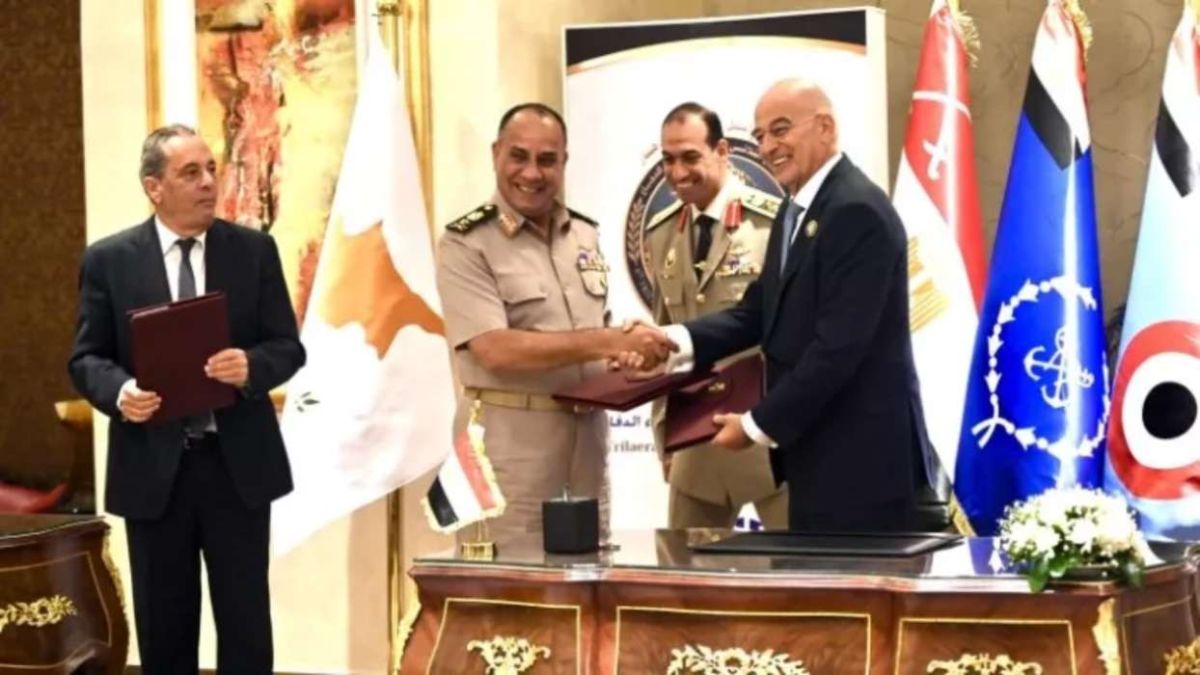
Greece, Egypt and Cyprus have taken another step toward deeper defense coordination in the Eastern Mediterranean, placing not only joint military exercises but also the capacity for a coordinated response to future threats at the center of their trilateral mechanism.
The joint declaration was signed in Cairo on September 22 by Greek Minister of National Defense Nikos Dendias, Egypt’s Minister of Defense and Military Production and Commander-in-Chief of the Armed Forces, Lt. General Ashraf Salem Zaher, and Cyprus Defense Minister Vasilis Palmas during the sixth trilateral meeting of the three countries’ defense ministers.
The document describes a broader framework for military cooperation at a time when armed conflicts and security challenges are reshaping the strategic environment across the wider region.
Crucially, the declaration does not identify any particular state as a threat. Instead, it addresses a broad spectrum of military and transnational security risks while explicitly grounding the trilateral cooperation in the UN Charter, the UN Convention on the Law of the Sea (UNCLOS) and international law.
Η τριμερής συνάντηση 🇬🇷 – 🇪🇬 – 🇨🇾 είναι ακόμα ένα βήμα στην εμβάθυνση των σχέσεων των κρατών μας. Το εξαιρετικά σαφές και εκτεταμένο κοινό ανακοινωθέν, νομίζω τα λέει όλα.
Η Αίγυπτος είναι ένας στρατηγικός και απαραίτητος σύμμαχος για την Ελλάδα και την Κύπρο. Εμείς οι Έλληνες,… pic.twitter.com/0EKKS9o8ug
— Nikos Dendias (@NikosDendias) September 22, 2026
The Key Phrase: “Rapid and Unified Response”
The strongest defense message appears in the final section of the declaration.
The three ministers agreed on the importance of strengthening military and defense cooperation frameworks in order to support:
“The collective capacity for a rapid and unified response to any future developments regarding threat sources of all kinds against the three countries.”
The wording is significant.
It does not, by itself, establish a mutual-defense treaty or a collective-defense guarantee comparable to NATO’s Article 5. No such commitment is contained in the declaration.
It does, however, signal an intention to move the trilateral relationship further toward a model of coordinated operational readiness.
Intelligence-Sharing and Coordinated Capabilities
The second element gives the agreement greater operational substance.
Greece, Egypt and Cyprus agreed to intensify communication, consultation and the exchange of information and assessments.
They also committed to:
“Coordinate joint capabilities in a manner commensurate with the gravity of current and future military and security threats and challenges at the regional level.”
This goes beyond the political symbolism of three governments exchanging assessments on developments in the Eastern Mediterranean.
The objective is closer coordination among three defense establishments in areas that can become critical during a regional crisis: information-sharing, situational awareness, military consultation and operational capabilities.
Energy Infrastructure Moves to the Front Line
One of the most consequential parts of the declaration concerns energy security.
The three sides said their views were aligned on strengthening joint protection frameworks for:
- supply lines,
- natural gas fields,
- offshore energy infrastructure in the Eastern Mediterranean.
The declaration specifically refers to protecting them against “various threats,” particularly in light of recent regional developments.
The language reflects the increasingly close relationship between energy and security in the Eastern Mediterranean.
Gas fields, offshore installations and maritime supply routes have strategic as well as commercial importance, while regional conflicts have increased concern over the vulnerability of critical infrastructure.
For Greece, Egypt and Cyprus, protecting energy infrastructure is therefore becoming part of the wider regional security architecture.
“Medusa” as an Operational Test
The trilateral military exercise “Medusa” occupies a prominent place in that architecture.
The three ministers praised the results achieved by forces participating in joint exercises, singling out “Medusa” for its contribution to stronger operational coordination and combat readiness.
According to the declaration, the exercise helps enhance readiness to deter “all forms of shared threats.”
Joint exercises provide the practical arena in which political defense cooperation can be tested operationally — from communications and command structures to interoperability and complex air and naval operations.
The message from Cairo is that these exercises are intended to remain a core component of the trilateral relationship.
UNCLOS and International Law at the Core
The declaration also carries an important diplomatic dimension.
Greece, Egypt and Cyprus reaffirmed that their cooperation mechanism is based on good-neighborly relations and regional security while adhering to:
the United Nations Charter, UNCLOS, relevant international agreements, international law, respect for state sovereignty and territorial integrity, and non-interference in domestic affairs.
The explicit reference to the UN Convention on the Law of the Sea is particularly notable in the Eastern Mediterranean, where maritime zones, offshore resources and competing claims have long been important geopolitical issues.
At the same time, the declaration does not name Turkey and does not characterize the trilateral mechanism as an alliance directed against Ankara.
That distinction is important when assessing the precise political meaning of the document.
From Terrorism to Maritime Security
The trilateral mechanism also extends beyond conventional military threats.
The ministers called for stronger coordination against a range of transnational security challenges, including terrorism, smuggling, irregular migration, human trafficking and organized crime.
Ensuring the security of maritime navigation is another stated priority.
This reflects a broader understanding of Mediterranean security, where a military conflict can rapidly affect shipping routes, energy infrastructure, migration flows and cross-border criminal activity.
For three states with major interests in the Eastern Mediterranean, these challenges are increasingly interconnected.
Deterrence — But Also De-escalation
Despite the stronger defense language, the Cairo declaration also contains a clear call for de-escalation.
The three ministers stressed the collective responsibility of the international community to help reduce current regional tensions.
They called for an immediate cessation of armed conflicts and for crises to be resolved through political means, warning against conflicts expanding geographically or continuing over prolonged periods.
Greece, Egypt and Cyprus also reaffirmed their commitment to maintaining constructive dialogue with all concerned parties in the interest of regional security and stability.
The architecture outlined in Cairo therefore has two parallel dimensions: stronger deterrence and operational readiness on one side, dialogue and de-escalation on the other.
A Trilateral Partnership With Greater Operational Depth
The most important development is not that Greece, Egypt and Cyprus are cooperating militarily. That relationship has been developing for years.
What is changing is the breadth of the areas they are seeking to connect.
Defense.
Intelligence.
Energy infrastructure.
Maritime supply lines.
Freedom and security of navigation.
Joint military exercises.
And, above all, the declaration introduces particularly strong language on a “rapid and unified response” to threats against the three countries.
That should not be interpreted automatically as a new mutual-defense guarantee.
It does, however, indicate that Athens, Cairo and Nicosia want their trilateral mechanism to acquire greater operational depth in an Eastern Mediterranean where military security, shipping and energy infrastructure are becoming increasingly intertwined.
The next step has already been agreed: the next meeting of the defense ministers of Greece, Egypt and Cyprus will take place in Greece during 2027.
Source: pagenews.gr
Διαβάστε όλες τις τελευταίες Ειδήσεις από την Ελλάδα και τον Κόσμο