Gerapetritis Draws Red Lines with Turkey: The Hague Only for EEZ, 12 Miles Are Athens’ Decision
 ΧΡΟΝΟΣ ΑΝΑΓΝΩΣΗΣ 10 '
Πηγή Φωτογραφίας: eurokinissi//Gerapetritis Draws Red Lines with Turkey: The Hague Only for EEZ, 12 Miles Are Athens’ Decision



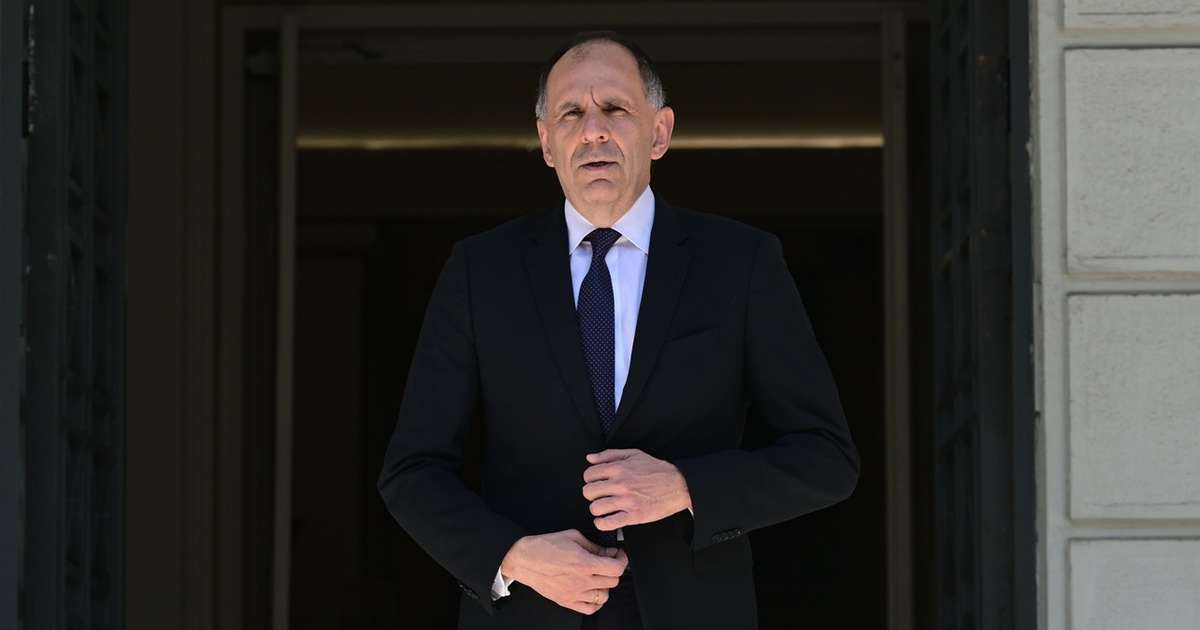
Greek Foreign Minister George Gerapetritis has delivered one of the clearest recent statements of Athens’ strategy toward Turkey, drawing three critical red lines at once: any referral to The Hague would concern only the delimitation of the continental shelf and Exclusive Economic Zone, Greek sovereignty is not open to negotiation, and Athens alone will decide when and how to exercise its right to extend territorial waters to 12 nautical miles.
In an interview with the newspaper Political, Gerapetritis effectively acknowledged that three years of structured Greek-Turkish dialogue have not yet produced the common ground required for the next major step: drafting a special agreement that could refer the dispute to international adjudication.
The reason goes to the heart of the Greek-Turkish disagreement.
Athens and Ankara still disagree not only over their respective positions, but over what exactly the dispute is.
The Hague: Athens rejects a broader package of Turkish claims
Greece’s position remains highly specific.
“The delimitation of the continental shelf and the Exclusive Economic Zone is the one and only difference between Greece and Turkey that may be brought before international jurisdiction,” Gerapetritis said.
That is the essential precondition for any special agreement.
According to the Greek foreign minister, Turkey seeks to broaden the scope of a potential judicial process by including claims that Athens considers to touch directly on issues of Greek sovereignty.
That is where Greece draws an absolute line.
“Sovereignty issues were, are and will remain outside the discussion,” he said.
He then delivered the key conclusion:
“Under the current circumstances, the conditions do not yet exist for a substantive discussion on a special agreement.”
In practical terms, this means that referral to The Hague remains a strategic option for Athens — but not at any price, and certainly not through an agreement that would legitimize Turkish sovereignty claims by placing them before an international court.

The real obstacle: Greece and Turkey still disagree on what is even negotiable
This may be the most important geopolitical point in the interview.
The problem between Athens and Ankara is not limited to different legal interpretations of maritime delimitation.
There is a prior, more fundamental dispute over the scope of the disagreement itself.
Greece recognizes one issue suitable for judicial settlement: the delimitation of the continental shelf and EEZ.
Turkey has for decades advanced a much broader range of claims.
Without convergence on the subject matter of the special agreement, the path to The Hague effectively stops before it begins.
That is why Gerapetritis’ statement matters.
It lowers expectations that continued diplomatic engagement automatically translates into negotiations over international adjudication.
The dialogue continues.
The Hague is not yet the next step.
The 12-nautical-mile issue is firmly back on the table
Even more significant is the foreign minister’s statement on the extension of Greek territorial waters.
Asked specifically whether Greece could move more quickly to extend its territorial sea south of Crete, Gerapetritis did not specify either timing or geography.
He did, however, restate the legal principle in unequivocal terms.
“The extension of our territorial waters to 12 nautical miles is an inalienable right of Greece deriving from the International Law of the Sea,” he said.
And crucially:
“The timing and manner of its exercise will be determined unilaterally by the Greek state, exclusively on the basis of the national interest.”
The word “unilaterally” is central.
Athens is making clear that the exercise of this right is not subject to negotiation with Ankara.
From the Ionian Sea to Crete — and the larger Aegean question
Gerapetritis reminded readers that the current government has already extended Greek territorial waters in the Ionian Sea and as far as Cape Tainaron.
“We have demonstrated in practice that on matters of sovereignty and sovereign rights we make no concessions,” he said.
The reference becomes more significant because the question specifically concerned waters south of Crete.
The minister did not announce a new extension.
But neither did he rule one out or make it dependent on any prior understanding with Turkey.
Strategic ambiguity remains over the timing.
There is no ambiguity over Athens’ legal position.
The Greece–Cyprus cable becomes a test of power and law
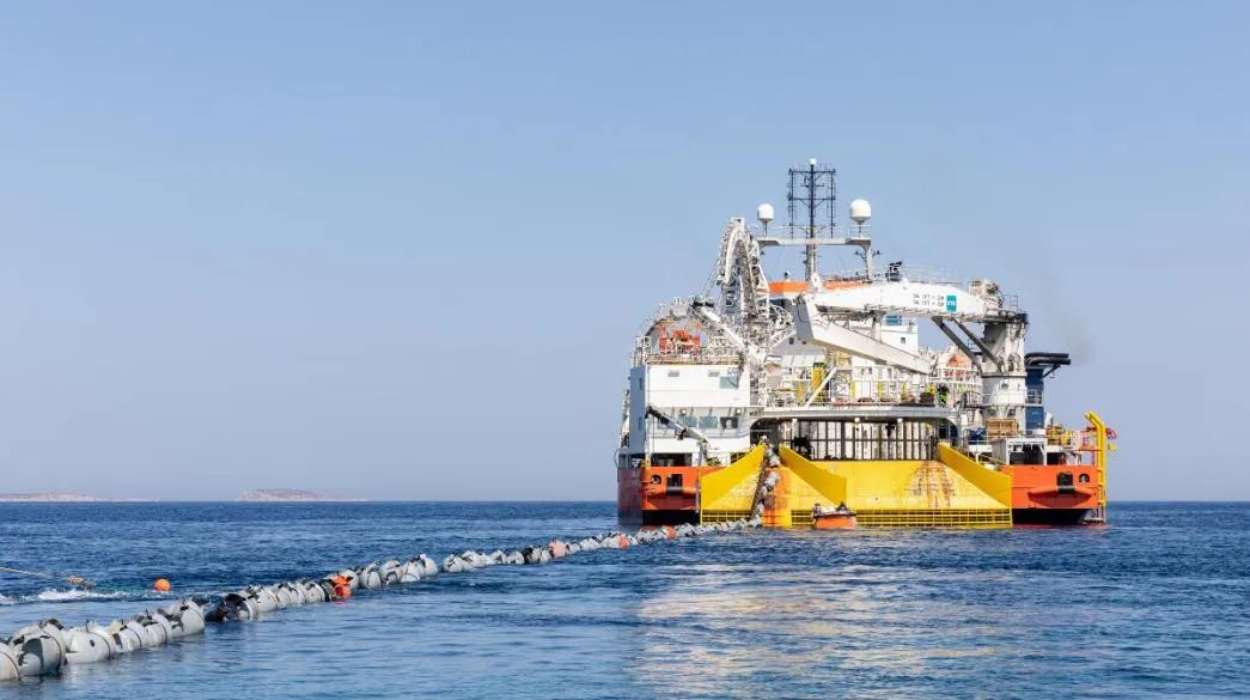
The second major strategic front in the interview concerns the Greece–Cyprus electricity interconnection.
Here too, the minister’s language was unusually strong.
Gerapetritis described the project as a Project of Common European Interest and stressed that it is fully compatible with the International Law of the Sea.
He also pointed to the participation of French company Meridiam as reinforcing the project’s European dimension.
Greece, Cyprus and France have all expressed political support for the project.
That moves the cable beyond the category of a simple bilateral energy infrastructure project.
It gives it a much broader European and geopolitical character.
On cable-laying: “There is no middle ground”
On this issue, Gerapetritis used one of the strongest formulations in the interview.
“On the issue of survey and cable-laying, which constitutes a freedom under the law of the sea, there is no middle ground.”
He added:
“Anyone who believes they can violate international and European rules without paying a price will ultimately pay with interest.”
The message is obvious even though Turkey was not named in that specific sentence.
Athens is signaling that any obstruction of survey activity or cable-laying will not be treated merely as another bilateral Greek-Turkish dispute.
Greece is seeking to place the project inside a wider framework of European interests, international law and strategic partnerships.
Article 42.7: Europe’s defence clause and its limits
The interview also contains an important reference to the EU’s mutual assistance clause.
Article 42.7 of the Treaty on European Union provides for assistance to a member state that is the victim of armed aggression.
Gerapetritis declined to pre-link the clause to a hypothetical incident involving the cable.
He did, however, confirm that discussions are under way at European level over how to make the clause more operational and effective, and that Greece is actively pushing for a roadmap clarifying what should happen following any activation.
The distinction matters.
Athens is not saying that any Turkish obstruction of the cable would automatically trigger Article 42.7.
It is saying that Greece is building multiple layers of deterrence: national, European, diplomatic and military.
EU, France and partnerships: A strategy of overlapping safeguards
The foreign minister effectively described a system of multiple security layers.
Greece has the European Union, its strategic relationship with France, its regional partnerships and its own defence capabilities.
“We have the EU by our side, France, with which we are linked by an Enhanced Strategic Partnership Agreement, and we have alliances and strategic partnerships with a number of countries in our wider region,” he said.
The significance is that Athens does not present any single mechanism as a stand-alone guarantee.
It treats them cumulatively as tools designed to raise the cost of any challenge to Greek or European interests.
The answer to Samaras: Dialogue does not mean appeasement
The interview also has a clear domestic political dimension.
Gerapetritis directly responded to criticism from former prime minister Antonis Samaras, who has accused the government of excessive accommodation toward Turkey and argued that appeasement creates new faits accomplis.
The foreign minister’s response rests on two arguments.
First, every Greek government — including Samaras’ own — maintained dialogue with Turkey.
Second, the key issue is not whether Athens and Ankara talk, but the relative position of power from which Greece now conducts that dialogue.
“Dialogue with Turkey is neither an innovation of the current government nor a sign of retreat. It is a longstanding tool of Greek foreign policy — and rightly so,” Gerapetritis said.
“Today is different”: The government’s new Turkey narrative
Gerapetritis then went a step further.
The government’s argument is now that Greece is not merely reacting to Turkish moves.
It is creating its own strategic facts on the ground through legally grounded initiatives.
The minister pointed to marine parks, maritime spatial planning, exploration of subsea resources and a broader projection of Greek presence in the region.
“Yes, today is different: Greece is taking initiatives on the ground and receiving the, to a large extent, expected reactions,” he said.
That is perhaps the clearest political answer to Samaras.
The government is seeking to move the debate away from the binary of “dialogue or confrontation” toward a different formula:
dialogue and power.
The emerging Athens–Ankara equation
Taken together, the foreign minister’s statements offer a relatively clear picture of Greece’s strategy for the next phase.
Athens is not abandoning dialogue with Ankara.
But it does not believe that dialogue has matured enough to produce a special agreement for The Hague.
It will not negotiate sovereignty.
It does not consider the 12-nautical-mile right dependent on Turkish consent.
And it is trying to transform critical projects such as the Greece–Cyprus electricity interconnection from bilateral points of friction into European strategic issues.
The policy can be summarized in four words:
dialogue, international law, alliances, deterrence.
The real test will come when these principles have to be applied simultaneously in the field.
That is where The Hague, the 12-nautical-mile issue and the Greece–Cyprus cable cease to be abstract diplomatic questions and become the three key stress tests of the next phase in Greek-Turkish relations.
Source: pagenews.gr
Διαβάστε όλες τις τελευταίες Ειδήσεις από την Ελλάδα και τον Κόσμο